
Email Notification
Enable and set up the email recipients to receive notification events from Suger service
Overview
Email notifications let you configure per-scope routing rules so that each notification event type has its own enable/disable toggle, recipient lists (TO, CC, BCC), and optional custom template. When an event from Suger matches a scope that is switched on in your saved configuration, and Enable Email Notification is on, an email is automatically sent to the designated recipients.
Configuration
Enable Email Notification
Go to the settings page and open the Notification tab. Toggle the Enable Email Notification switch to activate email routing.
While the switch is off, Suger sends none of the emails in the catalog. That includes the manual Notify Contacts action on private offers and the ready-to-accept email to an offer’s contacts. The page then shows the warning “Email Notification is off: every scope below is suppressed, including the manual Notify Contacts action on private offers.”
Email Routing Catalog
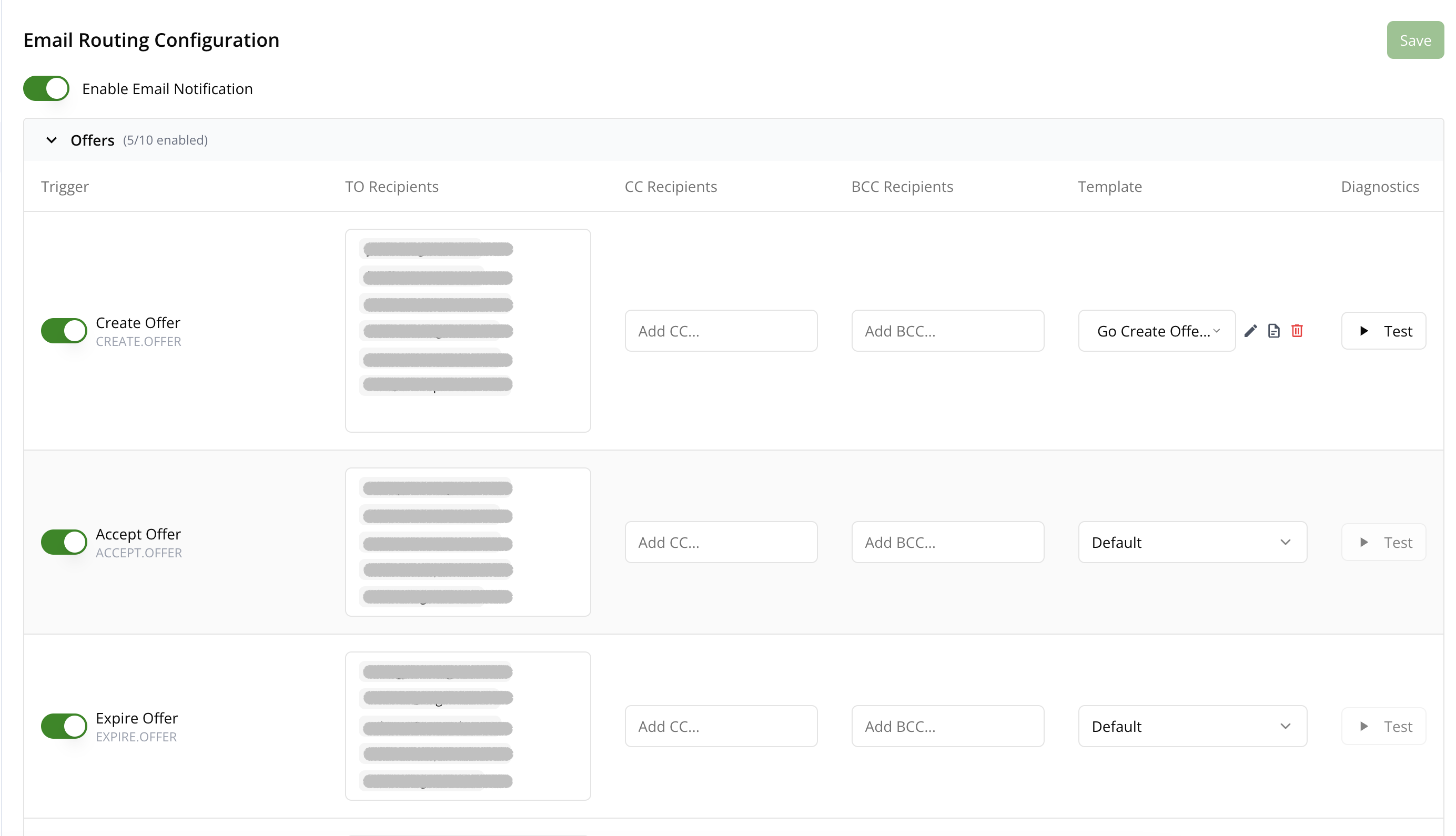
The Email Configuration catalog lists every notification scope, organized by category (Offers, Entitlements, Co-Sell, Partners, and so on). It is shown whether or not Enable Email Notification is on. Each category can be expanded or collapsed.
Every scope row provides the following columns:
| Column | Description |
|---|---|
| Trigger | Toggle to enable or disable the notification scope. The scope name and its raw identifier are displayed. |
| TO Recipients | Email addresses that receive the notification. Type an address and press Enter or comma to add. |
| CC Recipients | Email addresses to CC on the notification. |
| BCC Recipients | Email addresses to BCC on the notification. |
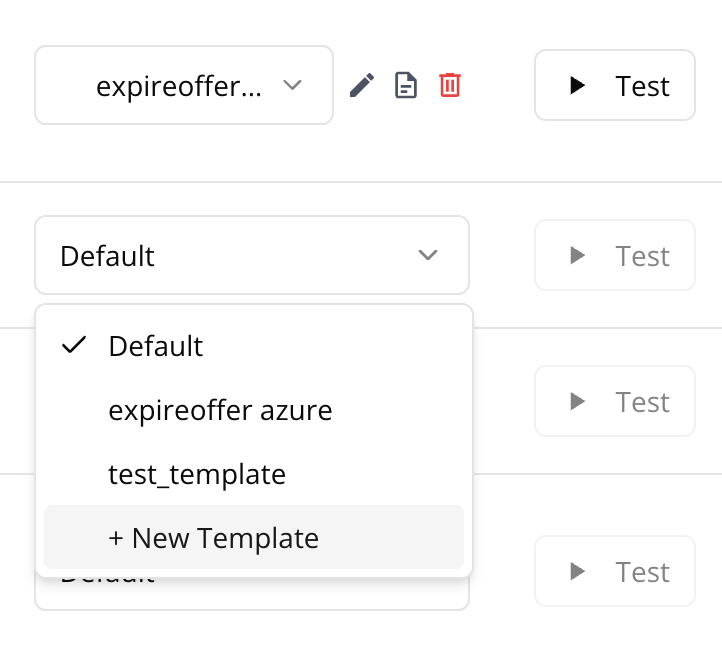
| Template | Select a custom email template from the dropdown, or choose + New Template to create one inline. When a template is assigned, icons appear to edit, view details, or delete it. |
| Diagnostics | Click Test to send a test email. With a custom template assigned, the test uses that template; with none assigned, it uses the scope’s default template. |
Click Save after making changes to persist your configuration.
Email an offer’s contacts
Suger reaches the contacts on an offer only through the Offer Notification Contacts rule on a row. Add the rule to each offer email your buyer’s contacts should receive: Pending Acceptance, Accept Offer, Resale authorization active, Notify offer contacts, or Accepted but unpurchased offers digest.
- Go to the settings page and open the Notification tab.
- Find the row in the catalog.
- In the row’s TO Recipients column, click Add roles, then under Suger select Offer Notification Contacts.
- Switch the row on.
- Click Save.
Everyone on a row receives the same email. The offer’s contacts and any other TO or CC recipients you add to that row appear together on one message.
Additional Settings
Below the catalog, one additional setting is available:
- Enable Expire Soon Offer Workflow Notification — Enables workflow notifications for offers that are about to expire. When enabled, you can configure the number of days before expiration to trigger the notification (default: 7 days).
The former Disable Email Notification on Offer Ready setting has been removed. To stop the ready-to-accept or resale-authorization emails, switch off the Pending Acceptance (PENDING_ACCEPTANCE.OFFER) or Resale authorization active (ACTIVE.OFFER) row in the catalog.
Update History
The Update History table at the bottom of the Notification tab shows an audit log of configuration changes. You can search across all fields and click a row’s detail icon to inspect the full JSON payload of the change.
Custom Templates
Custom email templates allow you to personalize your notification emails with dynamic content and professional layouts. You can create templates that automatically incorporate data from your notification events, making your emails more informative and engaging.
Any scope can have a custom email template assigned to it, replacing the default content. Templates support dynamic variables (for example, buyer name, deal name, and product).
Create New Template
In the routing catalog, find the Template column for any scope row and select + New Template from the dropdown. The template creation dialog opens, and once saved the new template is automatically assigned to that scope.
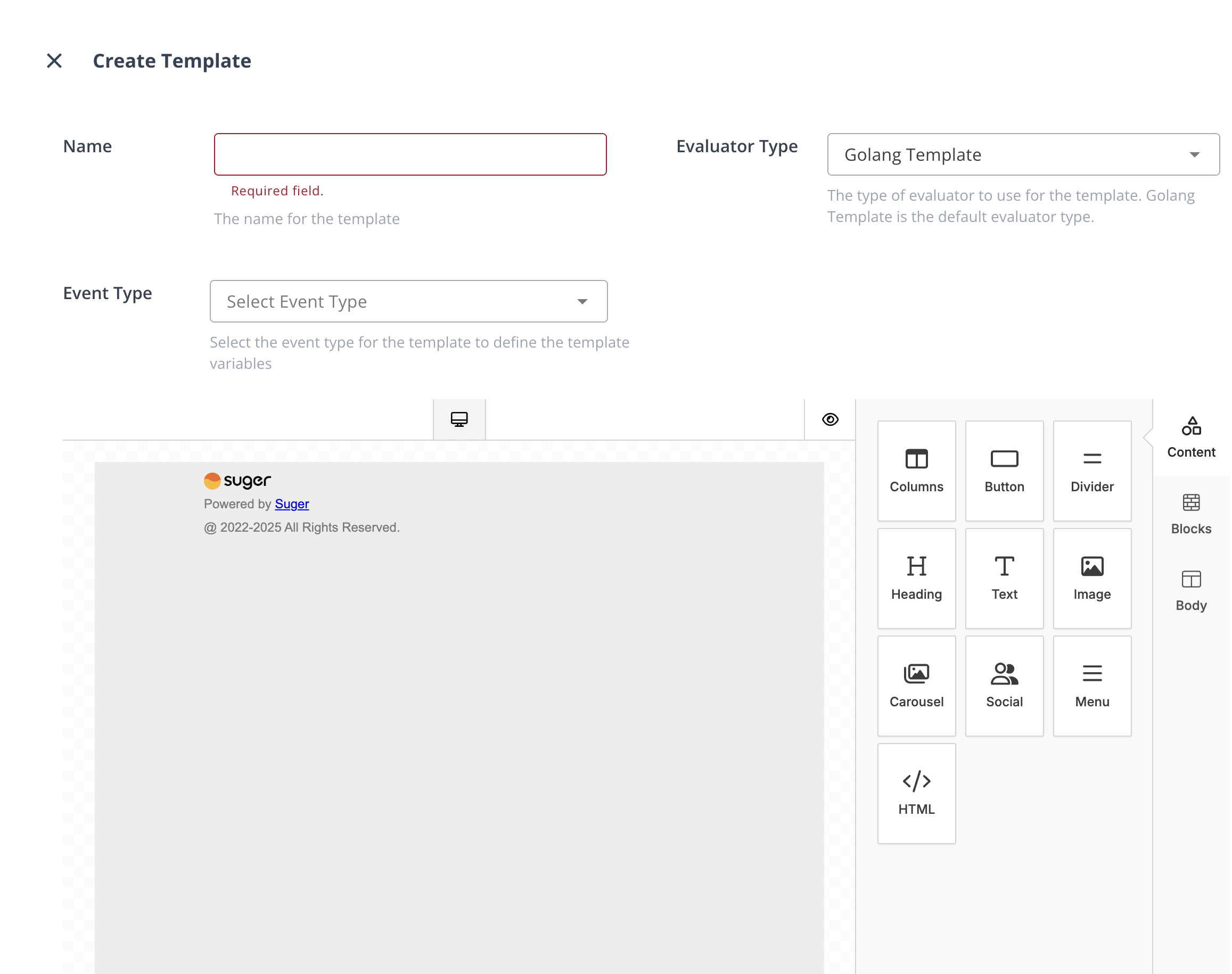
In the template creation dialog:
- Enter a descriptive name for your template
- Select the evaluator type (currently, only Golang Template is supported)
- Use the email builder to design your template
- Click Create to save your template
Use Email Builder
The email builder provides a comprehensive set of tools to create professional-looking emails:
- Columns: It allows your users to add columns to your design in order to have a better design arrangement.
- Button: Add any type of button in your email. You can change colors and styles.
- Divider: It gives your users appropriate spacing at any point they want in their design.
- Heading: Add headings (from level 1-6) to the design.
- Text: Text is a built-in tool so users can add text to their designs.
- Image: To make your emails attractive, you can add images using this tool.
- Social: It is a built-in tool that lets users add their social media icons to your design.
- Menu: Menu is a built-in tool used to create navigation menus.
- HTML: This tool will give your users room to add custom HTML to the design.
Working with Dynamic Data
Using Single Variables
-
Select a notification event type to make its variables available in the builder. By default, use the
BaseNotificationEvent. -
In the text or heading tool, click the
Merge Tagsbutton and select the variable you want to insert
Looping Over Lists
To display multiple items from a list:
- Add a Columns tool to your template
- Click the tag symbol on the Columns tool
- Select the list you want to iterate over
- For complex objects in the list:
- All variables from the list items become available within the Columns block
- Use them in text tools just like single variables
- For simple values (strings or numbers):
- Use the
thismerge tag to access the current item within the Columns block
- Use the
Assign Templates to Notification Scopes
Templates are assigned directly in the Email Routing Catalog:
- Go to the settings page and open the Notification tab
- Find the scope you want to customize in the routing catalog
- In the Template column, select an existing template from the dropdown or choose + New Template to create one
- When a template is assigned, use the inline icons to:
- Edit the template in the email builder
- View details as a JSON payload
- Delete the template (removes it from all scopes that reference it)
- Click Save to persist your changes
Duplicate a template
To start a new template from an existing one, open it for editing, for example with the Edit template icon next to a row’s template, and click Duplicate in the editor’s header.
- Suger saves what is on screen, including edits you haven’t saved, as a new active template named
<name>_copy. Further copies are named<name>_copy_2,<name>_copy_3, and so on, shortened if needed to fit the 50-character name limit. - The editor then switches to the copy, so your next Save updates the copy. The original template is left unchanged.
- The copy isn’t assigned to any row. Pick it from a row’s Template dropdown to use it.
Test Custom Templates
Before using a template in production, you can test it to ensure it works as expected:
- In the routing catalog, find the scope row with the template you want to test
- Click the Test button in the Diagnostics column
- In the test dialog, provide the following information:
- To Email: The recipient email address for the test
- CC Emails: Optional comma-separated list of email addresses to CC
- One event json data: Choose (and modify as you want) between:
- Mock JSON data files
- Last recorded events for your organization
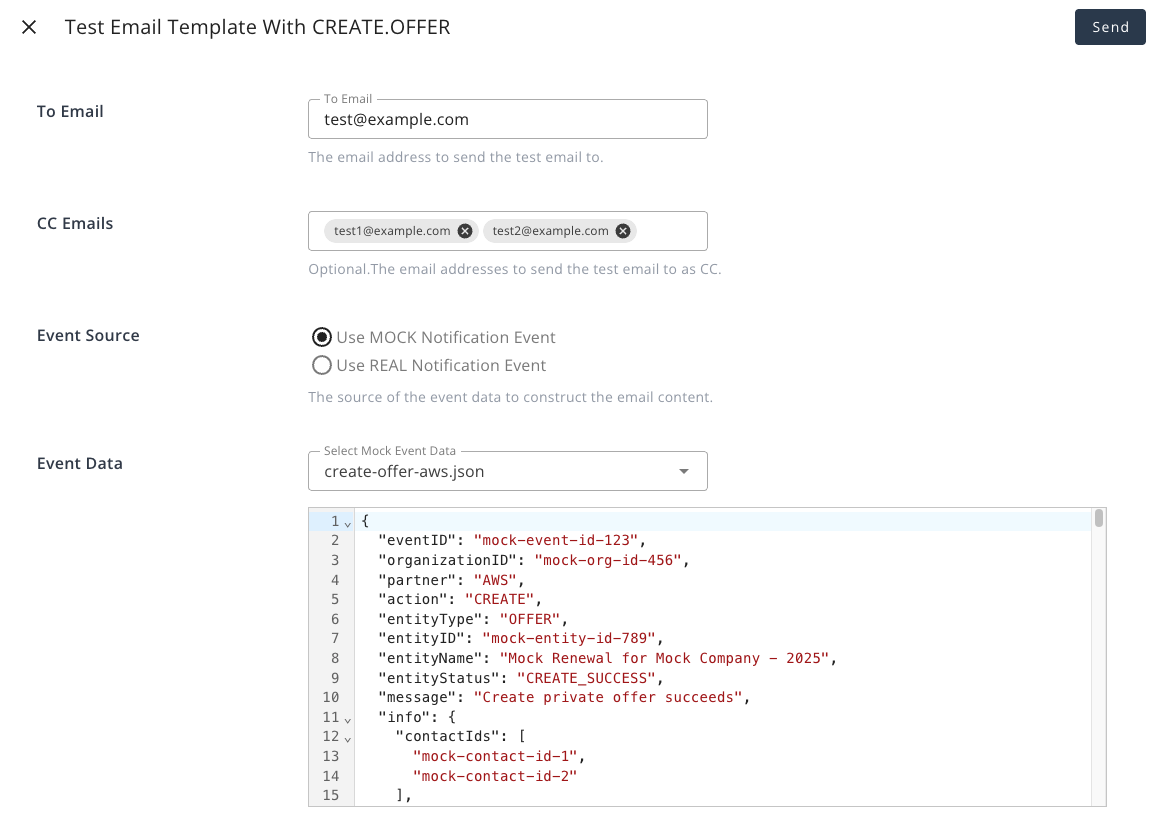
You can also edit the template directly from the test dialog by clicking the Edit Template button, which will open the email builder.
Test a scope’s default template
You no longer need a custom template to use Test. If a scope has no template assigned, the test sends that scope’s default template — the same content Suger would send in production — so you can check the wording and the event data a scope produces before deciding whether it needs customizing at all.
The partner-facing scopes (Partnership, Co-Sell, Commission, Certificate and Journey) render the production partners template, so what you receive is what your partners receive.
One exception: Product scope notifications are plain-text emails with no default template behind them. Test is disabled on that row, with the tooltip “This scope’s notifications are plain-text emails — assign a custom template to test.” Assign a custom template to that scope and the button becomes available.
Notification Scope Reference
Each notification scope has its own trigger, its own TO/CC/BCC recipient lists, and an optional custom template that replaces the default content. Use the tables below to understand when each scope fires and what its default email contains.
Keep in mind:
-
No row is always on — Co-sell shared, Co-sell closed won, Co-sell closed lost, Commission terms updated, and the commission rows can all be switched off like any other row.
-
Notices without a row — these have no row, so they can’t be switched off one by one:
- The email to a partner that a co-sell was registered on its behalf
- The email to a partner removed from a deal registration
- Certificate expiry and renewal reminders sent to learners
Enable Email Notification still applies to them.
-
A row takes effect only once it is saved — see When an email is sent.
Offers
| Scope | When it fires | Default email content |
|---|---|---|
Create OfferCREATE.OFFER | A new private offer is created in your organization | Offer name, buyer, product, pricing, expiry date, link to the offer |
Offer Creation FailedCREATE_FAILED.OFFER | A private offer fails to be created on the cloud marketplace | Failure reason (the offer’s error details) and a link to the offer in the Suger console so your team can fix and resubmit |
Accept OfferACCEPT.OFFER | A buyer accepts a private offer. The offer’s contacts receive this email only if the row is switched on and has the Offer Notification Contacts rule. See Email an offer’s contacts | Offer name, buyer details, acceptance timestamp |
Expire OfferEXPIRE.OFFER | A private offer has passed its expiration date without being accepted | Offer name, buyer, expiry date |
Update OfferUPDATE.OFFER | An existing offer is modified (e.g. pricing, expiry, terms) | Offer name, summary of what changed |
Delete OfferDELETE.OFFER | A private offer is deleted | Offer name, deletion timestamp |
Cancel OfferCANCEL.OFFER | A private offer is cancelled | Offer name, cancellation details |
Submit Approval RequestSUBMIT_APPROVAL_REQUEST.OFFER | A team member submits an offer for internal approval review | Offer details, submitter name, link for the approver to act |
Review Approval RequestREVIEW_APPROVAL_REQUEST.OFFER | An offer approval request is ready for a reviewer to act on | Offer details, approve/reject CTA |
Pending AcceptancePENDING_ACCEPTANCE.OFFER | An offer has been sent to the buyer and is awaiting their acceptance. The offer’s contacts receive this email only if the row is switched on and has the Offer Notification Contacts rule | Marketplace-specific template (AWS/Azure/GCP/Snowflake) with offer details and a direct acceptance link |
Resale authorization activeACTIVE.OFFER | An AWS resale authorization (CPPO) finishes creation and becomes active. Add the Offer Notification Contacts rule to email the offer’s contacts | Subject: Your Resale Authorization is Active. Steps for the channel partner to view the resale authorization in AWS Marketplace, with the product, AWS offer, channel partner, and resale authorization details |
Notify offer contactsNOTIFY_CONTACTS.OFFER | Someone clicks Notify Contacts on a private offer. The row’s Offer Notification Contacts rule resolves to the contacts picked in the dialog; the console shows the rule filled in on a row you haven’t saved yet. Switch the row off to turn off the action’s email | Follows the offer’s state: the ready-to-accept email for an offer pending acceptance, the resale-authorization email for an active AWS resale authorization, otherwise a general offer update |
Pending Partner ActionPENDING_PARTNER_ACTION.OFFER | An offer requires action from a channel partner (e.g. a CPPO step) | Offer name, required action, link |
Entitlements
| Scope | When it fires | Default email content |
|---|---|---|
Create EntitlementCREATE.ENTITLEMENT | A buyer subscribes and a new entitlement is created | Buyer, product, subscription start date, pricing |
Reinstate EntitlementREINSTATE.ENTITLEMENT | A previously suspended or cancelled entitlement is reinstated | Entitlement name, buyer, reinstatement date |
Suspend EntitlementSUSPEND.ENTITLEMENT | An entitlement is suspended (typically due to a payment failure) | Entitlement name, buyer, suspension reason, recommended next step |
Pending Cancel EntitlementPENDING_CANCEL.ENTITLEMENT | An entitlement has been scheduled for cancellation | Entitlement name, buyer, scheduled cancellation date |
Cancel EntitlementCANCEL.ENTITLEMENT | An entitlement is fully cancelled | Entitlement name, buyer, cancellation timestamp |
Update EntitlementUPDATE.ENTITLEMENT | An entitlement’s attributes are updated (e.g. seat count, pricing tier) | Entitlement name, buyer, summary of changes |
Meter EntitlementMETER.ENTITLEMENT | A usage metering record is submitted against an entitlement | Entitlement name, buyer, metered dimension, reported usage amount |
End Soon EntitlementEND_SOON.ENTITLEMENT | An entitlement is approaching its end date | Entitlement name, buyer, days until end date |
Terminate EntitlementTERMINATE.ENTITLEMENT | An entitlement is terminated (hard stop, distinct from cancellation) | Entitlement name, buyer, termination date |
Renew EntitlementRENEW.ENTITLEMENT | AWS Marketplace creates the next agreement in a pre-authorized auto-renewal chain | Entitlement name and confirmation that the agreement renewed |
Auto Renew OffAUTO_RENEW_OFF.ENTITLEMENT | AWS Marketplace reports that auto-renewal was turned off for an agreement | Entitlement name and the renewal opt-out lifecycle update |
Renewal UpcomingRENEW_SOON.ENTITLEMENT | AWS Marketplace reports an upcoming pre-authorized renewal | Entitlement name and the upcoming-renewal lifecycle update |
Renew_uplift_pending EntitlementRENEW_UPLIFT_PENDING.ENTITLEMENT | An AWS pre-authorized renewal has a price increase set as a range that you haven’t finalized, and the adjustment deadline is within 30 days. AWS sends no event for this: Suger’s own daily check sends it, at most once per renewal cycle. See Pre-Authorized Auto-Renewal | Subject: Action needed: finalize your renewal price uplift: [Entitlement Name]. Asks you to adjust the uplift before the deadline |
All four renewal scopes are disabled unless you enable the scope and configure recipients. For the three that AWS Marketplace reports (RENEW.ENTITLEMENT, AUTO_RENEW_OFF.ENTITLEMENT, and RENEW_SOON.ENTITLEMENT), repeated delivery of the same lifecycle event is deduplicated for one day. The Auto Renew value shown in the Console, Salesforce, and HubSpot is the buyer’s live accepted-agreement setting; it is not the separate “Renewal Offer” marker used when an offer replaces an existing agreement.
Co-Sell
These scopes cover activity on co-sell referrals shared via cloud marketplace co-sell programs (AWS ACE, GCP, etc.).
| Scope | When it fires | Default email content |
|---|---|---|
Archive ReferralARCHIVE.REFERRAL | A co-sell referral is archived | Referral name, cloud partner, archival timestamp |
Reject ReferralREJECT.REFERRAL | AWS or Google Cloud rejects a co-sell referral you shared | Referral name, cloud partner, rejection reason |
Accept ReferralACCEPT.REFERRAL | AWS or Google Cloud accepts a co-sell referral you shared | Referral name, cloud partner, acceptance timestamp |
Create ReferralCREATE.REFERRAL | A new co-sell referral is created | Referral name, cloud partner, deal details |
Create_failed ReferralCREATE_FAILED.REFERRAL | A co-sell referral you submit fails to be created with the cloud partner | Subject: Co-Sell Opportunity Failed to Submit to [Cloud]. Shows the referral’s latest failure reason and, when Salesforce (with the Suger app) or HubSpot is connected, an Open in CRM link to the referral there |
Approve ReferralAPPROVE.REFERRAL | AWS approves a co-sell referral you shared. Sent alongside Accept Referral | Referral name, approver, timestamp |
Update ReferralUPDATE.REFERRAL | A co-sell referral is updated (e.g. deal value, stage, customer info) | Referral name and a What Changed table (field, previous value, new value) of the watched fields that changed, such as stage, status, close date, next steps, deal value, and team members. If an update changes none of the watched fields, the default email isn’t sent; a custom template without the What Changed list keeps sending on every update |
Pending Acceptance ReferralPENDING_ACCEPTANCE.REFERRAL | A co-sell referral has been submitted and is awaiting cloud partner acceptance | Referral name, cloud partner, submission timestamp |
Inbound ReferralINBOUND.REFERRAL | A new inbound co-sell referral is received from the cloud partner | Referral name, cloud partner, customer details |
Every row except Inbound Referral covers referrals you share with a cloud partner. For a referral a cloud partner shares with you, Inbound Referral is the only email: accepting it (yourself or with Auto-Accept), declining it, and later updates to it send none.
Product
| Scope | When it fires | Default email content |
|---|---|---|
Create ProductCREATE.PRODUCT | A new product is created in your organization | Product name, marketplace, creator |
Update ProductUPDATE.PRODUCT | An existing product is updated | Product name, summary of changes |
Delete ProductDELETE.PRODUCT | A product is deleted | Product name, deletion timestamp |
Partners
These scopes cover activity in Suger’s Partner Relationship Management (PRM) module, including partnership invitations, Suger co-sells, and commission lifecycle events.
Co-sell and commission emails thread into a single conversation per deal. Suger sends each one from the first of these that applies:
- The Gmail of the signed-in user whose action triggered it, if they have connected Gmail as a user integration
- The organization sender chosen in the row’s Sender column: your organization’s Gmail or verified custom domain
- Suger’s default sender
Send co-sell emails from your Gmail has the full rules, the exceptions, and a diagram.
The sender decides the subject:
- Thread subject.
Co-sell: [Deal Name]on the share email andRe: Co-sell: [Deal Name]on every email after it, with the event named in the email body.- Used when the email comes from Suger’s default sender or from the Gmail of the person who triggered it.
- A copy that carries a recipient’s personal one-click link always comes from Suger’s default sender, so it uses this subject.
- Event-specific subject. Used when the email comes from your organization sender, which can’t carry the threading headers.
Both subjects are listed below. When you write inbox rules, use the one that matches how the email is sent.
| Scope | When it fires | Default email subject |
|---|---|---|
Accept PartnershipACCEPT.PARTNERSHIP | A partner accepts your partnership invitation | [Partner Company] accepted your partnership invitation |
Decline PartnershipDECLINE.PARTNERSHIP | A partner declines your partnership invitation | [Partner Company] declined your partnership invitation |
Accept SugercosellACCEPT.SUGERCOSELL | A partner accepts a seller-initiated Suger co-sell | Re: Co-sell: [Deal Name]; from your organization sender: [Partner Company] accepted your co-sell: [Deal Name] |
Decline SugercosellDECLINE.SUGERCOSELL | A partner declines a seller-initiated Suger co-sell | Re: Co-sell: [Deal Name]; from your organization sender: [Partner Company] declined your co-sell: [Deal Name] |
Co-sell sharedCREATE.SUGERCOSELL | A co-sell is shared. Your switch controls the share emails that land on your organization’s side | Co-sell: [Deal Name] (starts the thread); from your organization sender: You shared a co-sell: [Deal Name] with [Partner Company] (sharing side) or Co-sell: [Deal Name] — shared by [Sender] from [Sender Company] (receiving side) |
Partners — Deal update emailsDEAL_UPDATED.SUGERCOSELL | The seller saves a change to a partner-visible co-sell deal field (target close date, deal value, customer info, contacts, partner needs, notes, next steps, deal-value visibility). Each email shows a previous → new diff of exactly what changed. Intermediate pipeline stage moves never fire this — only Closed Won/Lost email, via their own scopes. Commission-terms changes keep their own notification. Off by default; enable it to start sending. The toggle governs what you send as the seller — recipients cannot switch these off, since the setting belongs to the org whose edits generate the emails | Re: Co-sell: [Deal Name] (these emails thread into the deal’s co-sell conversation); from your organization sender: [Seller Company] updated co-sell: [Deal Name] |
Co-sell closed wonCLOSE_WON_REMINDER.SUGERCOSELL | A party marks its co-sell copy Closed Won. A seller close-won notifies every partner; a referrer close-won notifies only the seller. Your switch controls the copies that land on your organization’s side | Re: Co-sell: [Deal Name]; from your organization sender: Co-sell closed won: [Deal Name] |
Co-sell closed lostCLOSE_LOST.SUGERCOSELL | A party marks its co-sell copy Closed Lost. Your switch controls the copies that land on your organization’s side | Re: Co-sell: [Deal Name]; from your organization sender: Co-sell closed lost: [Deal Name] |
Commission terms updatedCOMMISSION_TERMS_UPDATED.SUGERCOSELL | The seller edits partner-visible commission terms on a live co-sell, and the partner is notified. Your switch controls the copies that land on your organization’s side | Re: Co-sell: [Deal Name]; from your organization sender: [Seller Company] updated the commission terms for [Deal Name] |
Pending CommissionPENDING.COMMISSION | A commission is created and awaiting seller approval | Re: Co-sell: [Deal Name]; from your organization sender: Commission pending approval: [Deal Name] |
Approve CommissionAPPROVE.COMMISSION | A seller approves a commission payout | Re: Co-sell: [Deal Name]; from your organization sender: Your commission for [Deal Name] has been approved |
Payment Sent CommissionPAYMENT_SENT.COMMISSION | A seller marks a commission payment as sent to the partner | Re: Co-sell: [Deal Name]; from your organization sender: Payment sent for [Deal Name] |
Payment Confirmed CommissionPAYMENT_CONFIRMED.COMMISSION | A partner confirms receipt of a commission payment | Re: Co-sell: [Deal Name]; from your organization sender: [Partner Company] confirmed receipt of payment — [Deal Name] |
Auto Confirmed CommissionAUTO_CONFIRMED.COMMISSION | A commission is auto-confirmed after the confirmation window passes without action | Re: Co-sell: [Deal Name]; from your organization sender: Commission auto-confirmed for [Deal Name] |
Clawback CommissionCLAWBACK.COMMISSION | A commission is reversed | Re: Co-sell: [Deal Name]; from your organization sender: Commission reversed for [Deal Name] |
Auto-Share Report
| Scope | When it fires | Default email content |
|---|---|---|
Complete Auto Share TaskCOMPLETE.AUTO_SHARE_TASK | An automated data-sharing task completes successfully | Task name, completion time, report summary and link |
Fail Auto Share TaskFAIL.AUTO_SHARE_TASK | An automated data-sharing task fails | Task name, failure reason, recommended remediation steps |
Headless Entitlements
| Scope | When it fires | Default email content |
|---|---|---|
Notify Headless EntitlementsNOTIFY.HEADLESS_ENTITLEMENTS | A headless entitlement (one without a buyer-facing signup flow) is created or requires attention | Entitlement name, marketplace, buyer info, link to the entitlement detail |
Revenue
| Scope | When it fires | Default email content |
|---|---|---|
Disburse Revenue RecordDISBURSE.REVENUE_RECORD | A revenue record disbursement is processed by Suger | Disbursement amount, billing period, product, buyer |
Suger Co-Sell
There is no separate row for the people on a Suger co-sell. The share email they receive is governed by the Co-sell shared row (CREATE.SUGERCOSELL) in Partners.
Unpurchased Offers
| Scope | When it fires | Default email content |
|---|---|---|
Accepted but unpurchased offers digestNOTIFY.UNPURCHASED_OFFERS | One email per Azure private offer that meets all three conditions: it is currently accepted, it was created during the default 14-day reporting window (which ends one hour before the check), and it has no entitlement yet. Sent only when Enable Unpurchased Azure Offer Report is on and Treat Accepted Offers as Purchased is off in your Azure integration | Subject: Your Azure Private Offer is waiting for purchase. Its audience is the Offer Notification Contacts rule; add the rule to the row if it isn’t there |
Usage Metering Alerts
| Scope | When it fires | Default email content |
|---|---|---|
Abnormal Alert Usage Record GroupABNORMAL_ALERT.USAGE_RECORD_GROUP | An abnormal usage pattern is detected in a usage record group | Subject: [Suger Alert] Abnormal Usage Record Groups Detected — includes the affected entitlement, metric name, anomalous values, and a link to your usage metering dashboard |
Spotted something wrong or out of date on this page? Tell us and we'll correct it.