
Revenue Settings
Revenue Settings is where you configure how revenue is reported, review each channel’s sync configuration, and choose which bank accounts feed cash matching. Open it from Revenue → Settings — the page is titled Configuration and has two tabs: Revenue Settings and Bank Accounts.
Overview
Open Revenue → Settings. Unlike the rest of the workspace, Settings is not scoped by the channel filter.
Revenue reporting policies
A revenue reporting policy controls whether revenue is reported gross (full invoice amount) or net (after channel fees) for a given scope. The policies table lists each policy’s level, channel, product, reporting basis, source, effective dates, and last update.
To add or change a policy:
- Select Add Policy (or the Edit action on an existing row).
- Choose the channel and, optionally, a product.
- Choose the reporting basis — Gross or Net.
- Set the effective from and effective to dates.
- Save.
Validation: the effective-from date cannot be in the past, and effective-to must be on or after effective-from. Use Delete to remove a policy you no longer need.
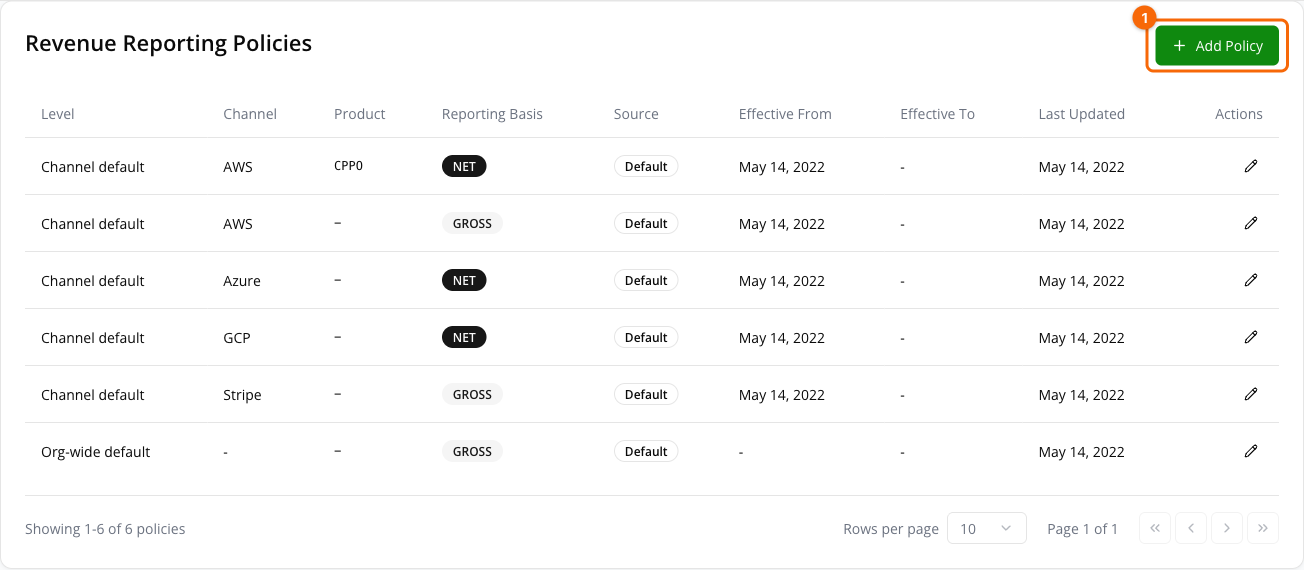
The ① Add Policy button (circled) creates a new rule. Each row shows the policy’s Level (Channel default or Org-wide default), Channel, Product, and Reporting Basis (GROSS or NET) — for example, AWS CPPO reports NET while Stripe reports GROSS. Use the Edit action at the end of a row to change it.
Recognition policies (ASC 606)
Directly below the reporting-policy table, the Recognition Policies card sets how revenue is recognized over time under ASC 606 — separate from the gross-or-net question above. This card lives here on Settings, not on the Revenue Recognition dashboard.
Four recognition methods are supported:
| Method | Recognizes revenue |
|---|---|
| STRAIGHT_LINE | Evenly across the service term. This is the default when no policy applies. |
| POINT_IN_TIME | All at once, at the moment of transfer. |
| USAGE_BASED | In line with metered consumption. |
| MILESTONE | When a defined milestone is reached. |
Multi-element allocation, percentage-of-completion, and ramp models are not available.
A policy is resolved most-specific-first: an org-wide default, overridden by a channel default, overridden by a product policy, and a per-record manual override beats all three. Each row shows which of those resolved it, so you can tell a policy you wrote from one Suger derived.
Some methods take extra parameters, supplied as a JSON method configuration on the policy.
Channel sync configuration
Each connected channel (AWS, Azure, GCP, Stripe) appears as a card showing its connection status (VERIFIED), last sync time, and error count. Two values describe how that channel ingests data:
- Schedule — Daily. This is a fixed displayed value, not a choice and not a promise about cadence: the control is locked to Daily, and the effective schedule is set by Suger server-side. A channel with no stored sync configuration actually defaults to hourly, and the sync interval Suger reports for connection health varies by channel again. Read this field as Suger manages the schedule, not as this channel syncs once a day.
- Backfill Months — 24. Also locked. Connecting a channel pulls up to 24 months of history; the amount is not adjustable per channel.
Both fields are read-only, so Save re-applies the standard configuration to that channel rather than saving a custom one. Connect a revenue channel first if the list is empty.
Bank Accounts
The Bank Accounts tab manages the connected accounts used for cash matching against your revenue records.
Open it directly at /revenue/bank-accounts, or from Revenue → Settings → Bank Accounts. The dedicated path exists because bank providers redirect back to an exact URL when they finish linking an account.
The header carries two actions — Refresh, which re-syncs account state, and Connect Stripe — above the summary cards: Connected Accounts, Active Accounts, and Institutions.
Summary cards
| Card | Meaning |
|---|---|
| Connected Accounts | Total bank accounts connected for sync and cash matching. |
| Active Accounts | Connected accounts currently in an active state. |
| Institutions | Distinct financial institutions across connected accounts. |
Connecting an account
Suger supports two bank connectivity providers: Plaid and Stripe Financial Connections. There is no third — Tink has no implementation and is not planned.
- Connect Stripe opens Stripe Financial Connections. It does not require your organization to connect a Stripe billing integration.
- Plaid links are completed by returning from the provider’s own OAuth redirect. There is no Connect Plaid button on this page; the tab resumes an in-flight Plaid link when the provider redirects back to it, and tells you to start again if that link has expired.
Either way, connecting an account starts transaction import immediately. The first import pulls 24 months of history; every sync after that re-reads a 7-day overlap window before the last cursor, so transactions the bank posts late or corrects are still picked up. Plaid additionally pushes updates to Suger over a signed webhook, so Plaid-linked accounts do not wait for the next poll.
Unlinking an account
Each ACTIVE row in the accounts table carries an Unlink action.
- Select Unlink on the account’s row.
- Confirm at the Unlink bank account? prompt.
Unlinking stops future transactions from syncing. Existing transactions and reconciliation history are preserved — you are disconnecting the feed, not deleting the record. Rows that are not active do not offer the action.
The accounts table lists each account’s name, provider, currency, status, last sync, and provider account reference.
Transactions imported here are what Bank Reconciliation matches against your invoices, payouts, and payment transactions.
KPI calculation formulas
The Revenue Settings tab has no KPIs. The Bank Accounts tab shows connection counts:
| KPI | Applies to | Formula | Calculation details |
|---|---|---|---|
| Connected Accounts | Plaid, Stripe Financial Connections | count(connected bank accounts) | — |
| Active Accounts | Plaid, Stripe Financial Connections | count(accounts with active status) | — |
| Institutions | Plaid, Stripe Financial Connections | count(distinct institutions) | Distinct financial institutions across connected accounts. |
Spotted something wrong or out of date on this page? Tell us and we'll correct it.