
Cash & Disbursements
The Cash & Disbursements page (sidebar → Cash & Disbursements) tracks the money on its way to you — marketplace and Stripe payouts, plus the installments still to come.
Overview
Open Revenue → Cash & Disbursements. The page has three summary cards, a per-channel payout summary, a disbursement schedule, and a future-installments table; select any schedule row to open its payout detail. For what buyers still owe you, see Invoices.
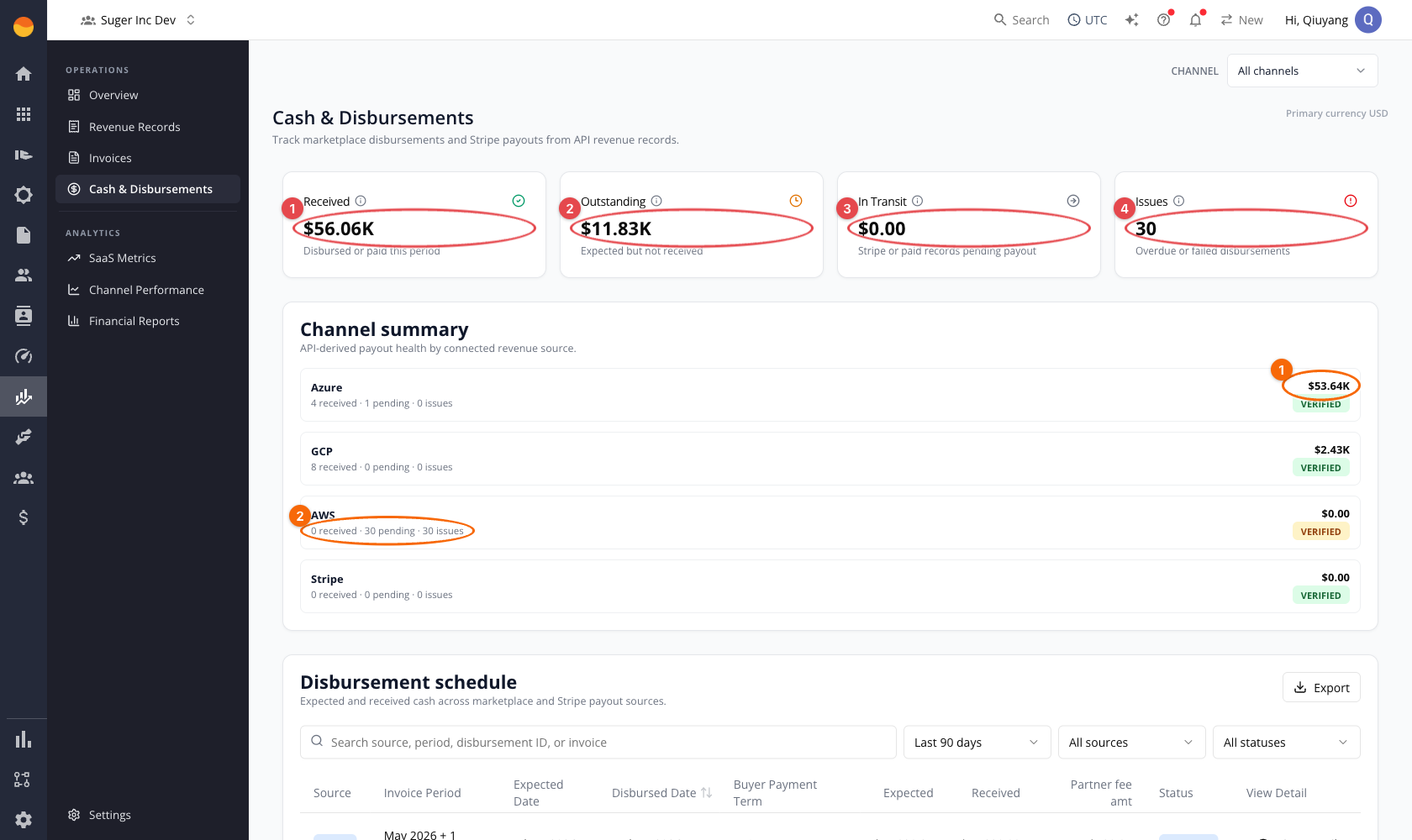
Summary cards
| Card | Meaning |
|---|---|
| Received | Payouts received for the current scope — the amount that landed, counting Received, Est. Received, and flagged payouts alike. |
| Outstanding Payout | Expected payout amount not yet received. |
| Issues | Count of disbursement rows that need review — Overdue, flagged, or Failed. The card’s in-product subtitle reads Overdue, flagged, or failed disbursements. |
A flagged payout is one where the amount received did not match the amount expected, so it deliberately lands in all three cards at once: its received amount counts toward Received, its shortfall counts toward Outstanding Payout, and it counts once toward Issues.
Est. Received — a GCP-only status
GCP rows carry a status the other channels do not: ESTIMATED, labelled Est. Received in the table. Google reports a payout amount but never a payout date, so Suger settles a GCP row against its expected payout date — the 21st of the month after the charge month — instead of an actual one. A row that has passed that date with a confirmed amount shows Est. Received; one that has passed it with nothing confirmed shows Overdue; one that has not reached it yet stays Pending. See GCP Revenue for the full lifecycle.

The cards read left to right — Received, then Outstanding Payout, then Issues, which is a count of payouts needing review rather than an amount.
A per-channel summary shows received, pending, and issue counts with each connection’s sync status.
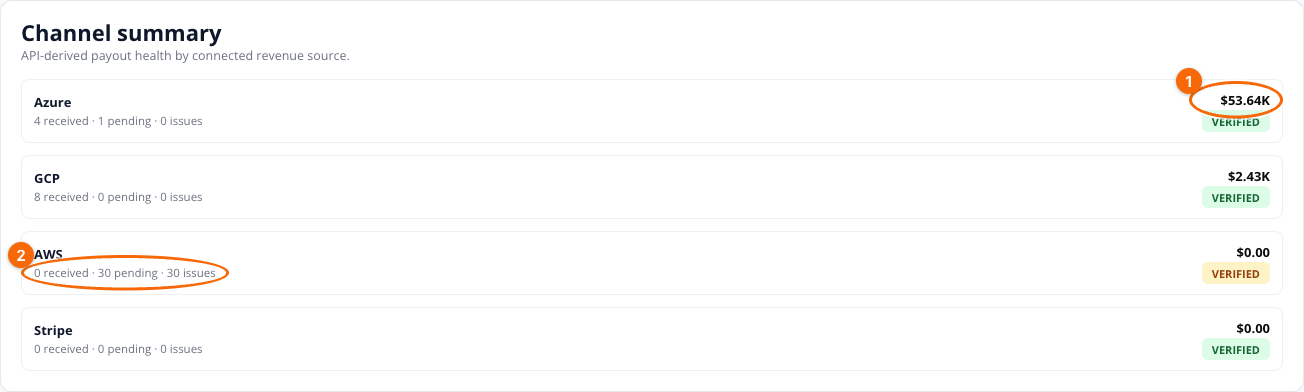
Each row rolls up one channel’s payout health — ① its total received amount and ② its received · pending · issues breakdown — so you can see, for example, that AWS has 0 received · 30 pending · 30 issues while Azure shows no issues (one payout still pending).
Schedules and installments
- The disbursement schedule table lists each expected payout with its source, invoice period, expected and received dates, amount, and status.
- The future installments table lists upcoming installment payouts by marketplace, offer, buyer, due date, currency, and amount.
The schedule identifies the buyer by Buyer ID and Buyer Name as separate columns, and carries the payout Currency. Both the Expected and Received columns are sortable.
Filter the disbursement schedule by search, date range, source, status, and currency; filter future installments by source, date range, and currency. Use Export on the schedule or Export CSV on installments to download — the schedule export includes Buyer ID, Buyer Name, and Is Estimated.
The future installments date range looks forward from today: This Month, Next 3 Months (the default), Next 6 Months, Next 12 Months, Next 24 Months, Next 36 Months, or All Time. Each range runs from today to the last day of its final month — Next 3 Months ends on the last day of the third month after this one — and All Time has no end date, so it lists every installment still to come. The table’s Total row adds up every installment that matches the filters, not just the page on screen, with a separate total for each currency.
To inspect a single payout:
- Locate the disbursement in the disbursement schedule table.
- Select View Detail on its row.
- Review the payout summary, linked invoices, refund activity, and the source payload in the detail modal.
- Close the modal to return to the schedule.
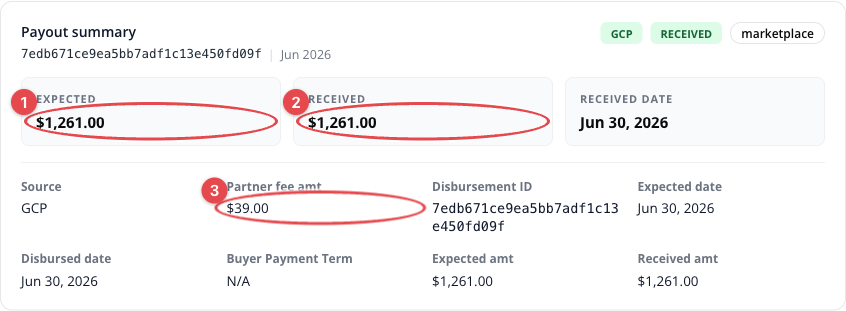
The payout summary circles the three figures you reconcile most: ① Expected (what the channel owed), ② Received (what actually landed), and ③ Partner fee amt (the channel’s cut). Below the summary the modal also lists the linked invoices and the raw source payload. Refunds are shown per linked invoice, so a refund is attributed to the invoice it reversed rather than to the payout as a whole.
The Linked invoices table lists every invoice the payout covers:
| Column | What it shows |
|---|---|
| Invoice | The invoice number, linked to that invoice’s detail on Invoices. Beneath it: the buyer’s name — or No buyer linked / Buyer name unavailable — and how many entitlements the invoice covers. |
| Disbursed Amount | On an AWS payout, the invoice’s share of the cash in that payout. On any other row, the payout expected for that invoice — its collectable amount, else its invoice amount, else its disbursed amount, converted at the record’s stored rate — so it can show a figure before the payout lands. |
| Partner Fee Amount | The channel’s fee on that invoice: the AWS fee lines allocated to it, the channel fee on the record for other marketplaces, or the Stripe processing fee, never below zero. |
| Status | The invoice’s payment status on that payout. |
The same modal opens from Matched To on Bank Reconciliation when a matched record belongs to a payout.
To confirm the deposit itself reached your bank, match it in Bank Reconciliation.
Refund activity
A Refund activity card on this page collects refunds across the channels, so you do not have to open payouts one at a time to find them.
Two totals sit at the top:
| Total | What it is |
|---|---|
| Deducted From Payouts | Refunds already taken out of a payout. |
| Pending Refunds | Refunds not yet deducted. |
Filter the rows by status:
| Status | Meaning |
|---|---|
| Disbursed | The refund has been settled through a payout. |
| Issued | The refund has been issued but not yet settled. |
| Request pending | The refund has been requested and is awaiting processing. |
Each row shows the invoice the refund is matched to, and the card has its own Export.
This is the cross-channel view. The per-payout view is unchanged: refunds are still shown per linked invoice inside a disbursement’s detail modal, attributed to the invoice they reversed.
KPI calculation formulas
All amounts are in your base currency. See Revenue Settings for base-currency and FX handling.
| KPI | Applies to | Formula | Calculation details |
|---|---|---|---|
| Received | AWS, Azure, GCP, Stripe | Σ received amount of **RECEIVED, ESTIMATED and FLAGGED** payouts in scope | All three statuses count. Rows are windowed by expected date; received date is used only when there’s no expected date. A flagged payout contributes the amount that actually arrived, so it counts here as well as in Outstanding Payout (for its shortfall) and in Issues. ESTIMATED is GCP-only. |
| Outstanding Payout | AWS, Azure, GCP, Stripe | Σ expected amount of pending and overdue payouts + Σ max(0, expected − received) for flagged payouts | Payouts the channel still owes you, on the same expected-date window as Received. A flagged payout — one where the amount received did not match the amount expected — contributes only its shortfall, so a payout that arrived in full adds nothing. |
| Issues | AWS, Azure, GCP, Stripe | count(payouts in Overdue, Flagged, or Failed status) | Matches the card’s subtitle, Overdue, flagged, or failed disbursements. Unmatched deposits and reconciliation variances are surfaced elsewhere — see Bank Reconciliation. |
| Future installments Total | Accepted contract offers with a payment schedule, on any channel | Σ installment amount, per currency | Over every installment that matches the source, currency, date-range, and search filters — not just the page on screen. Each currency is totalled separately and not converted. The range starts today and ends on the last day of its final month; All Time has no end. |
Spotted something wrong or out of date on this page? Tell us and we'll correct it.