
Microsoft Outlook
Allow Suger to access your Microsoft Outlook account to send, receive, and manage emails on your behalf.
Overview
By integrating Suger with Microsoft Outlook, users can leverage automation workflows to enhance email productivity. Tasks such as sending emails can be automated, improving efficiency and enabling customized email workflows tailored to specific business needs.
Org-Level vs User-Level
Org-Level: Uses Azure AD app registration for organization-wide access. User-Level: Each user authenticates via Microsoft OAuth for personal Outlook access.
Create Integration (Org-Level)
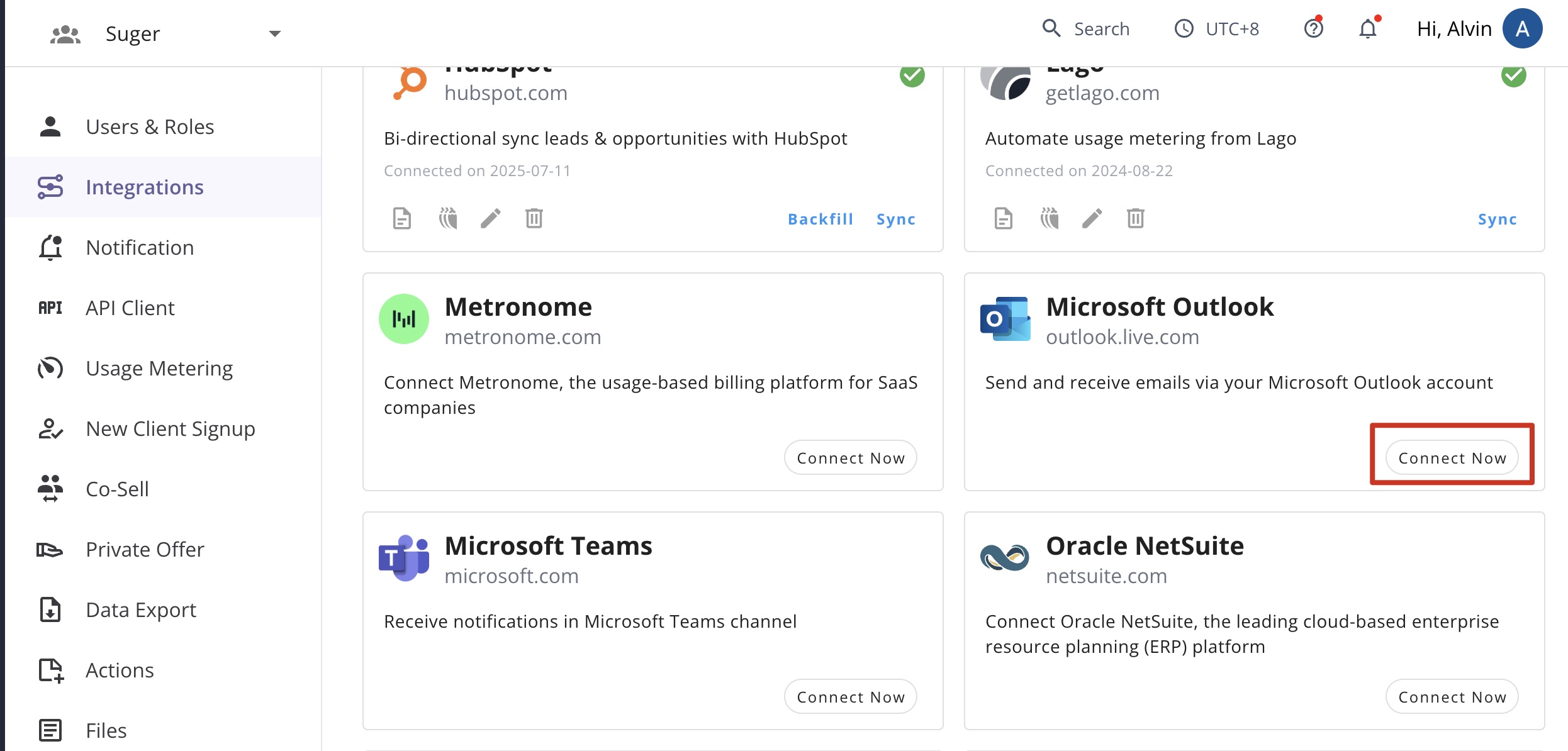
- Click the
Connect Nowbutton, you will be redirected to the Microsoft OAuth2.0 authentication page.
- Click the
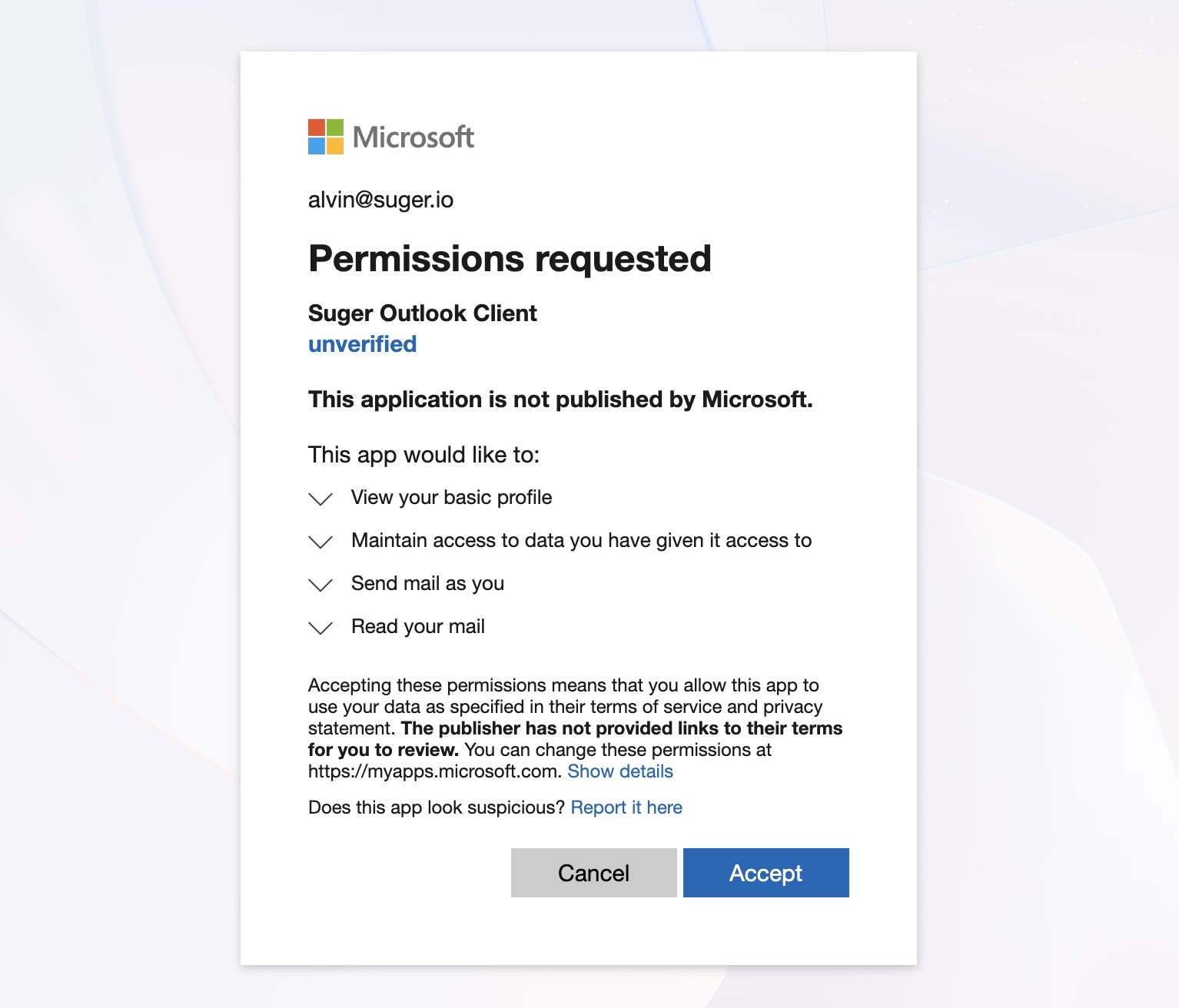
Acceptbutton to grant Suger permission to access your Outlook account. This authorization enables Suger to read, send emails on your behalf.
-
After the authorization is granted, you will be redirected to the Suger console. You can see the integration is connected successfully.
-
Verify the integration by clicking the
Verifybutton. If the integration is successful, you will see theVerifiedstatus.
Create User Integration
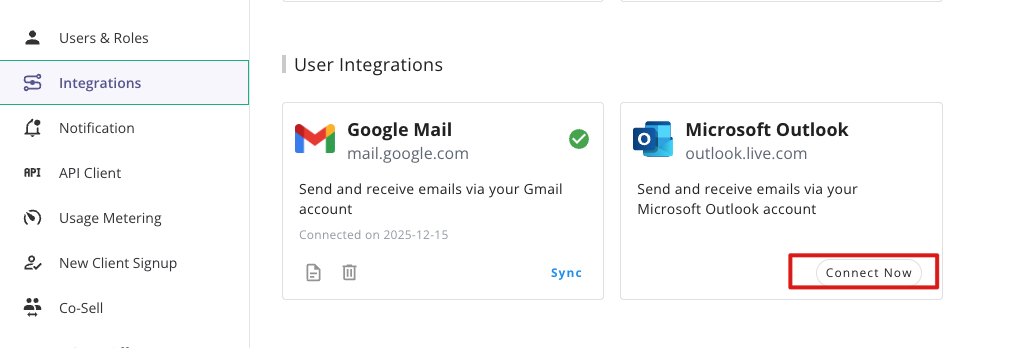
- Click the
Connect Nowbutton in the User Integrations section, you will be redirected to the Microsoft OAuth2.0 authentication page.
- Click the
Acceptbutton to grant Suger permission to access your Outlook account. This authorization enables Suger to read, send emails on your behalf.
-
After the authorization is granted, you will be redirected to the Suger console. You can see the integration is connected successfully.
-
Verify the integration by clicking the
Verifybutton. If the integration is successful, you will see theVerifiedstatus.
Suger AI Tools
Suger AI uses a middleware strategy — wrapping the Microsoft Graph Mail API directly.
Org-level and user-level: Both integration levels are supported. User-level takes precedence when both are connected.
Profile & Folders
| Tool | Description |
|---|---|
outlookmail_get_profile | Get the authenticated user’s Outlook profile |
outlookmail_list_folders | List all mail folders with unread counts |
Messages
| Tool | Description |
|---|---|
outlookmail_list_messages | List messages with OData filter or full-text search |
outlookmail_get_message | Get a full message including body and attachments list |
outlookmail_send_mail | Send an email (plain text or HTML) |
outlookmail_reply_to_message | Reply to a message preserving threading |
outlookmail_update_message | Mark as read/unread, flag, or assign categories |
outlookmail_move_message | Move a message to another folder |
outlookmail_delete_message | Move a message to Deleted Items |
Drafts
| Tool | Description |
|---|---|
outlookmail_list_drafts | List saved drafts |
outlookmail_create_draft | Save an email as a draft |
outlookmail_update_draft | Replace a draft’s content |
outlookmail_send_draft | Send a previously saved draft |
outlookmail_delete_draft | Permanently delete a draft |
Edit Integration
For security purposes, editing an existing Microsoft Outlook integration is not allowed. The practical way is to delete it and then re-create it from the beginning.
Delete Integration
The Microsoft Outlook integration can be deleted like all other integrations. Once the deletion is triggered, all integration info including the credentials and access tokens will be deleted immediately & permanently from Suger. No time window or methods to recover.