
Configuration
Configure to automate your co-sell flow.
Overview
Once you have completed integrations with your CRM and the cloud partners, you will need to configure the field mappings, templates, and other options before starting making referrals.
Co-sell settings act as the translation layer between your CRM (Salesforce or HubSpot) and cloud partner portals — AWS Partner Central, Azure Co-Sell, and GCP Partner Advantage. Once configured, your sales team can register deals and track referrals without leaving their CRM or manually re-entering data in each partner portal.
Prerequisites
Before you begin, make sure:
- You have admin access to Suger Console > Settings.
- Salesforce or HubSpot is already connected under Settings > Integrations.
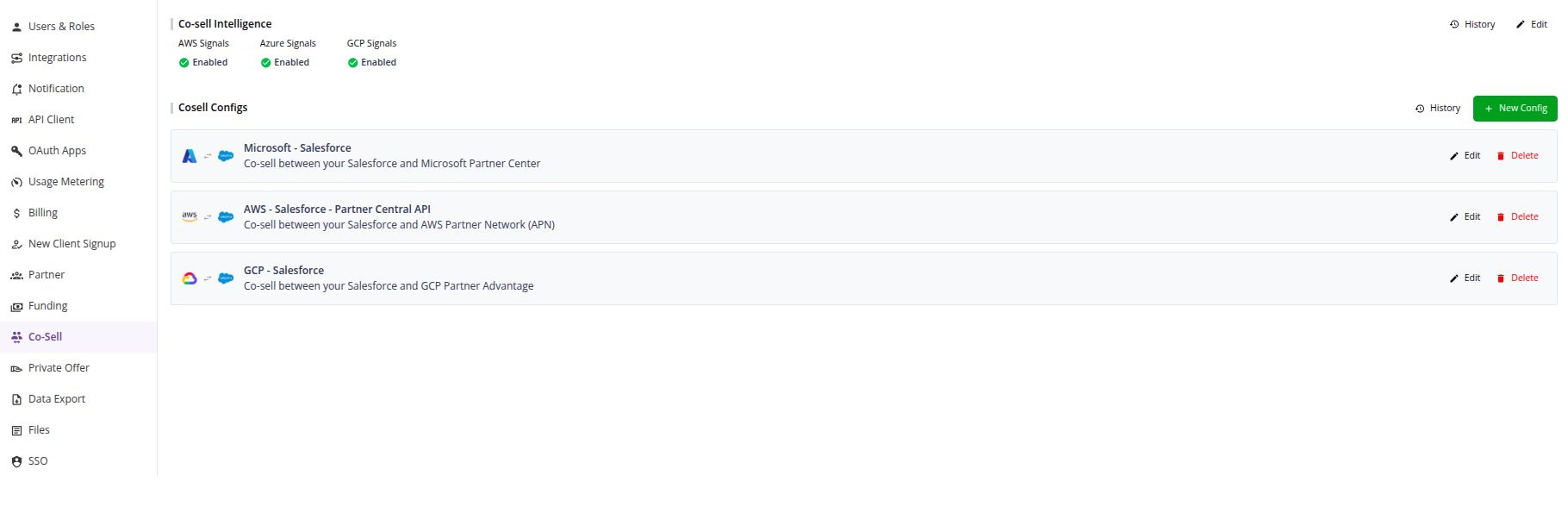
Display Setting of Co-sell Intelligence
Co-sell Intelligence surfaces AWS, Azure, and GCP engagement signals (Low/Medium/High) directly in your CRM widget.
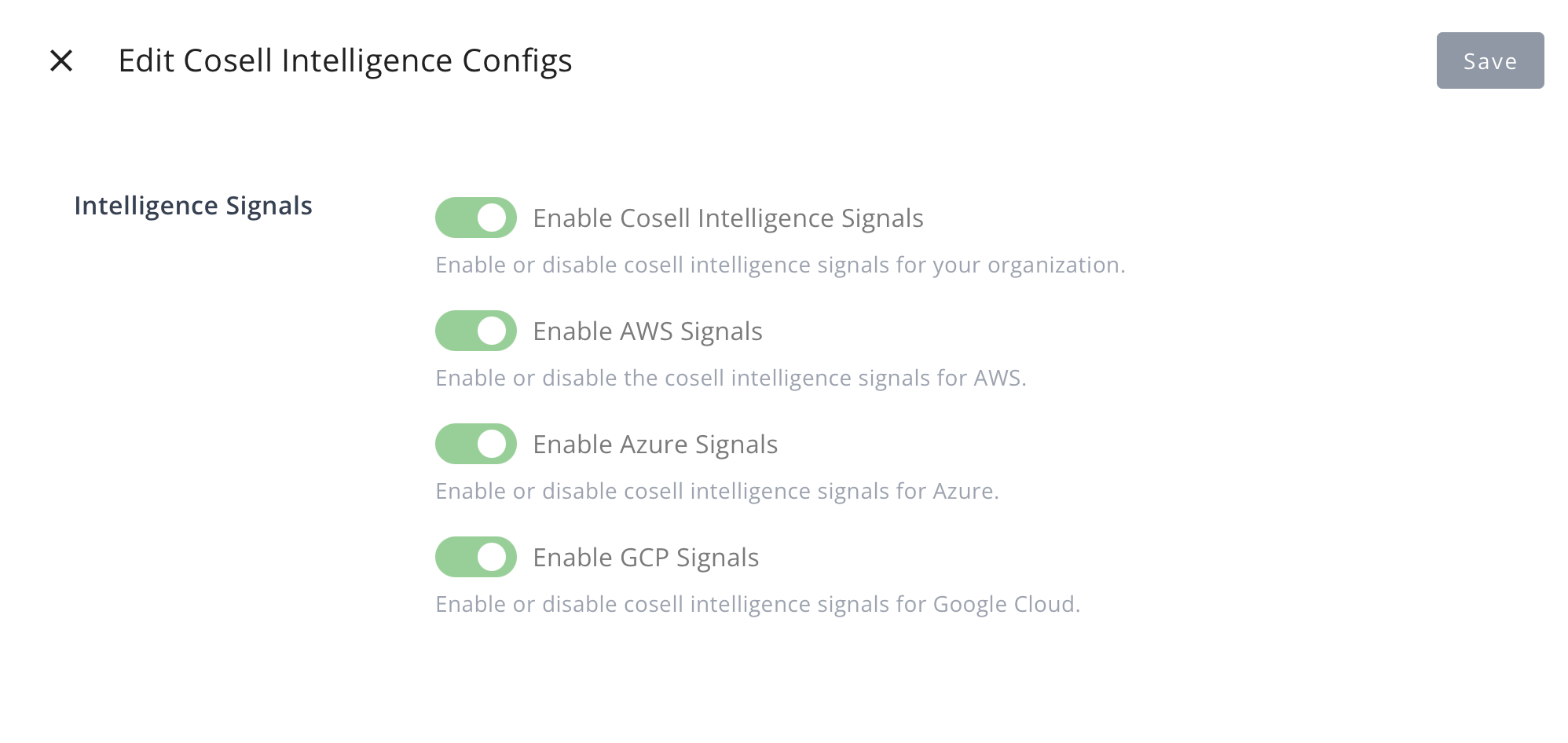
Once Suger has enabled them, signals surface per cloud partner. A partner that has not been switched on shows no data even while Co-sell Intelligence itself is on, so tell support which of AWS, Azure, and GCP you want covered.
Two different “enrichment” features
Two features share the word enrichment but do different things. Keep them apart when you configure or troubleshoot:
| Feature | What it fills | When it runs |
|---|---|---|
| Auto-Enrich Referrals | Blank referral fields — company address, website, contact details — on the referral you are about to share | At share time, when the referral is previewed or prepared |
| CRM intelligence-signal enrichment | Intelligence signals written into mapped fields on your Salesforce Account/Opportunity or HubSpot Deal/Company records | On a schedule, every 2 hours (previously every 12 hours) |

Auto-Enrich never touches your CRM objects — it only completes the outgoing referral. Intelligence-signal enrichment never touches referral fields — it only writes signals into the CRM fields you have mapped for them.
The 14 intelligence signals
Intelligence-signal enrichment writes 14 values:
| Cloud partner | Signals |
|---|---|
| AWS | AWS Engagement Score · AWS Marketplace Count · AWS Marketplace Review Count · AWS Marketplace Purchase Count |
| Azure | Azure Engagement Score · Azure Event Score · Azure Usage Score · Azure Marketplace Count · Azure Marketplace Review Count · Azure Marketplace Purchase Count |
| GCP | GCP Engagement Score · GCP Marketplace Count · GCP Marketplace Review Count · GCP Marketplace Purchase Count |
The engagement score rates how likely the customer is to be won through that partner’s co-sell motion. The marketplace counts describe the customer’s own footprint on that marketplace — products listed, reviews on those products, and purchases made. Azure adds two extra scores: Event Score (how many interactions the customer has had with Microsoft) and Usage Score (how much the customer uses Azure services).
Each signal is written only to the Salesforce or HubSpot field you map it to. Signals with no mapped field are simply not written.
Create a new configuration
Each configuration is a dedicated bridge between one CRM source and one cloud partner network.
- Go to Suger Settings.
- Choose “Co-Sell” in the submenu, and click the
New Configbutton.
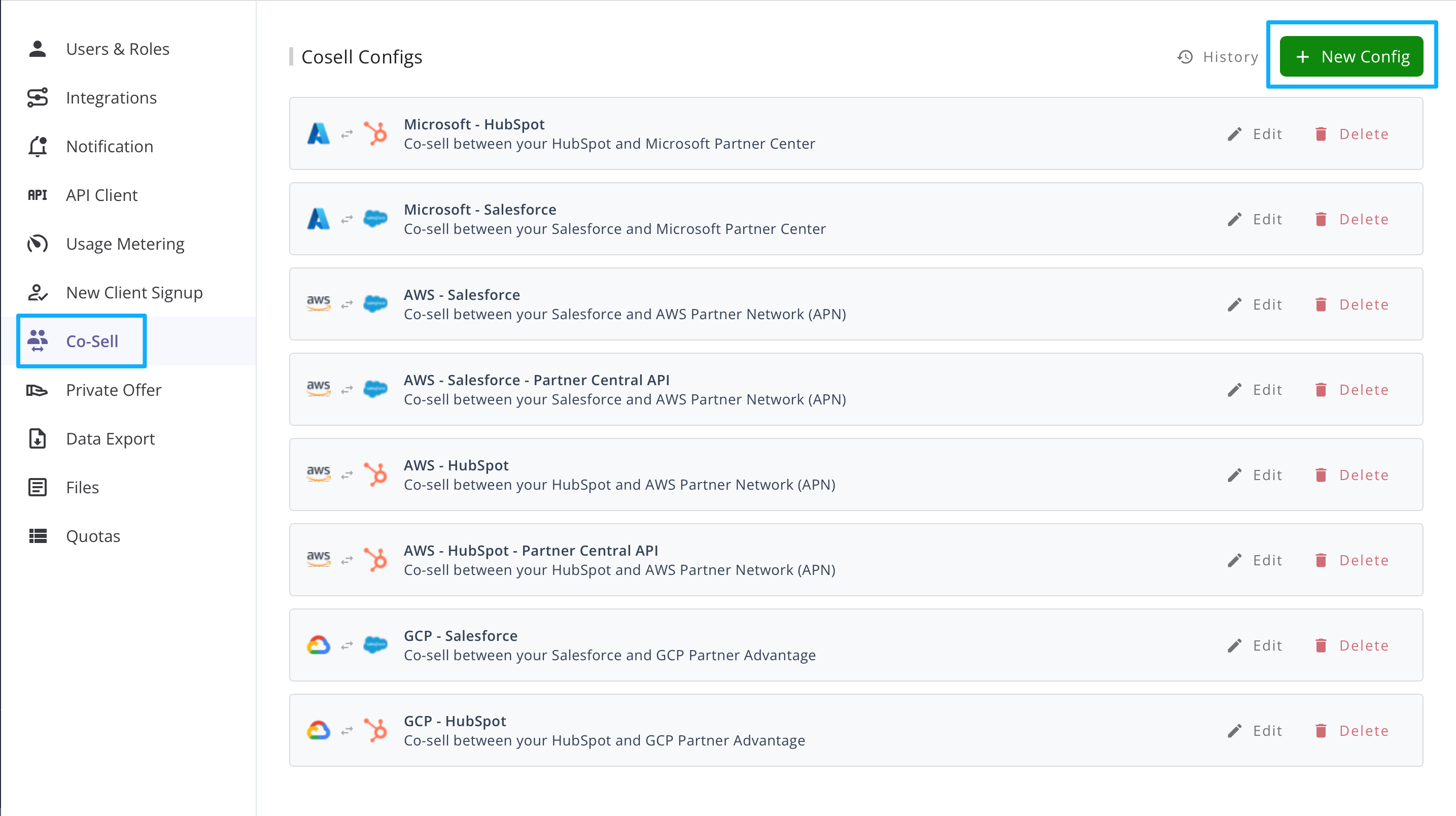
- Choose the CRM Partner (Salesforce or HubSpot) and the Cloud Partner (AWS, Azure, or GCP) to proceed.
Outbound Setting
The Outbound Sync section defines the data flow from your CRM platform to Cloud Partners, indicating that information is pushed outward from the CRM system.
Field Mapping
Field mapping configuration is used to control how fields are pre-filled when you create a new referral share from CRM to Cloud Partners. If the auto-share referrals setting is turned on, this configuration will be applied to all automatically shared referrals.
It also affects the Suger Connector in CRM software.
In the configuration table, the title of each row represents the field name in the Cloud Partner. You can use the search dropdown to select which CRM field should be mapped to it. You can add or remove Cloud Partner fields to customize your own mapping rules.
Some fields may be marked with an asterisk (*), which means they are required fields and must be filled in before submission.
Use Picklist Value Mapping (if available) or Expression Mode to define complex data-mapping rules, including conditional logic, value conversions, and cross-field mappings.
See the related section for detailed documentation and examples.
For each partner field, choose one of four mapping methods:
| Mapping Method | Use case | Example |
|---|---|---|
| Default Value | A hard-coded value sent for every referral. Best for information that’s mandatory for the partner but identical across your company — Partner ID, alliances team alias, sales-lead email, listing ID. | Sales_Lead_Email → alliances@company.com |
| Direct & Picklist Mapping | Links a CRM field 1 to a partner field. For dropdowns, map every active CRM value to a partner-approved value. Best for standard fields like Close Date, or aligning deal stages to partner stages. | Opportunity.CloseDate → Partner.Target_Close_Date |
| Expression Mode | A dynamic logic engine using Go Templates (text/template) syntax — calculations, concatenations, fallbacks, and cross-field lookups. | {{- multiply .Amount 0.8 -}} (net revenue) or {{.Name}} {{.Account.Name}} (unique title) |
| AI Generate | Describe the value you want in a natural-language prompt and Suger generates it with AI when the referral is shared. You can reference source fields with {{.FieldName}}. Available on five supported AWS ACE fields: Industry Vertical, Partner Primary Need from AWS, Postal Code, Customer Business Problem, and Estimated AWS Monthly Recurring Revenue. | Write a business problem statement based on {{.Description}} |
Sync Fields
The Sync Fields configuration controls whether Suger will update an item to Cloud Partners at the next scheduled sync time when a corresponding field value changes in the CRM.
To enable syncing for a specific field, turn on the Enable Syncing toggle on the right side of the field.
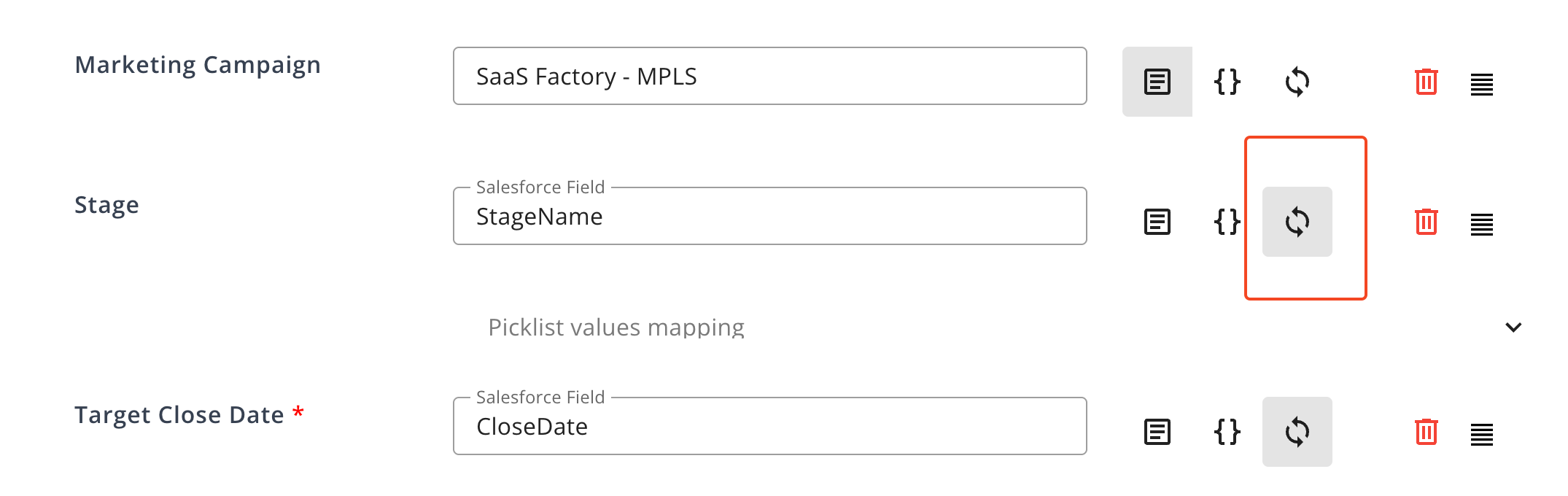
You can configure the following options:
- Conditional sync with Expression Mode: Click the {} icon next to a field to enable Expression Mode, which allows you to define conditional synchronization rules based on custom logic. Refer to the section below for details on using Expression Mode.
- Picklist values mapping: Use this feature to define custom value mappings between CRM and Cloud Partner fields. Refer to the related section below for details on using Picklist values mapping.
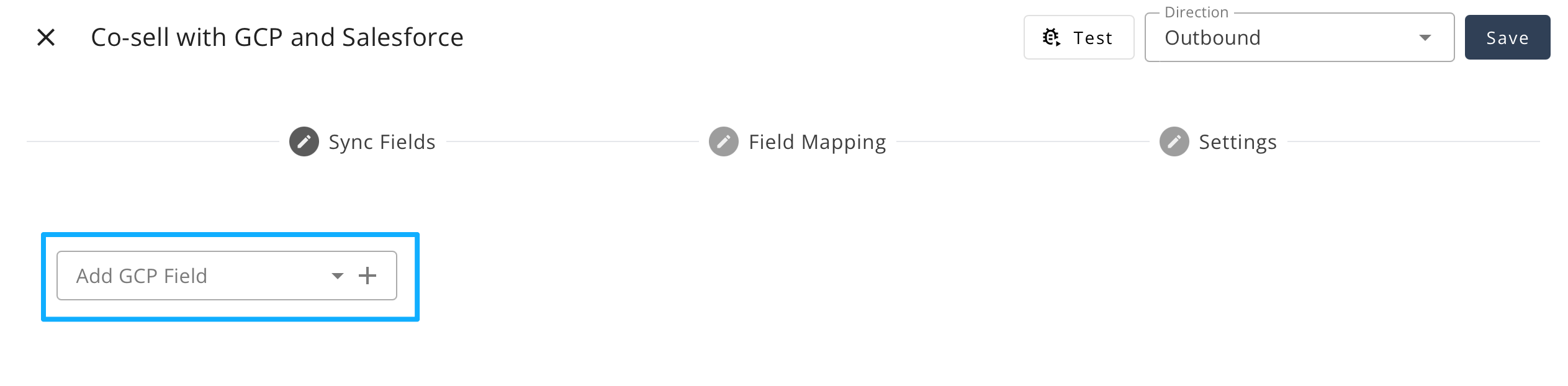
- Add a Cloud Partner field: Scroll down the page and search for a field name under the selected Cloud Partner in the lower-left panel. Click the field to add it to the configuration list.
Settings
The referral automation settings allow you to automatically manage the referral sharing workflow from your CRM to Cloud Partner.
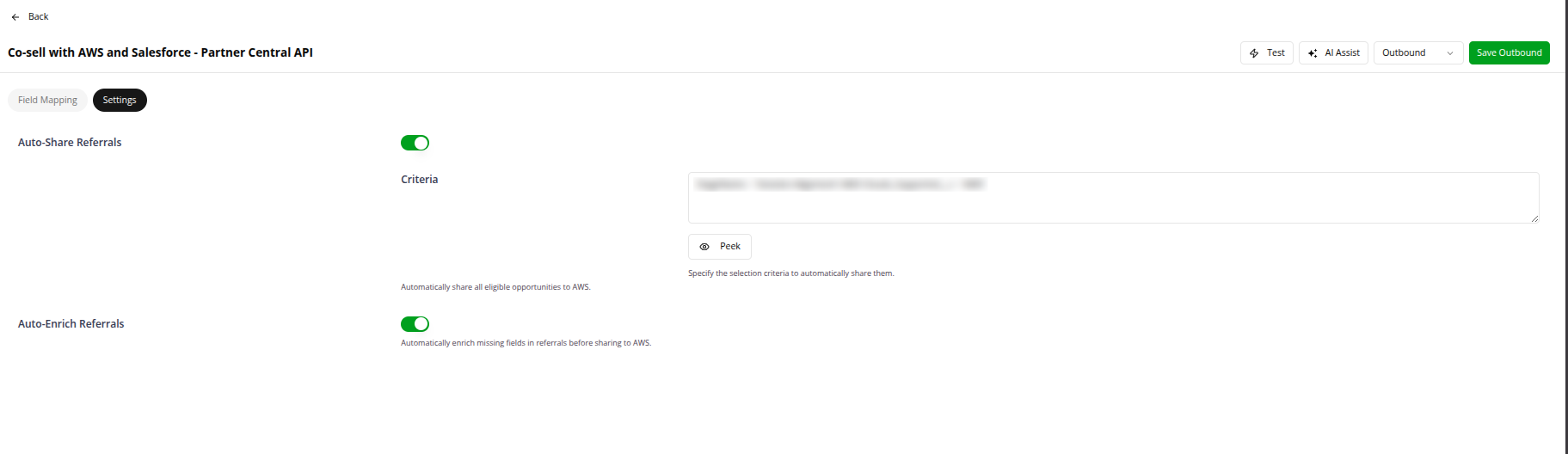
Auto-Share Referrals
Automatically share all eligible opportunities from your CRM to Cloud Partner. When this option is enabled, any opportunity that meets the sharing criteria will be submitted without manual action.
 Salesforce Only – Conditional Criteria Setting
The Criteria field under Auto-Share Referrals narrows auto-share to the records you want. Only records that meet the condition are included in the next auto-share cycle.
You can express that condition two ways, using the segmented tabs at the top of the Criteria editor:
| Tab | What you get |
|---|---|
| Builder | A visual condition tree — pick a field, an operator, and a value, and combine rows with AND / OR groups. No SOQL syntax to remember. |
| Advanced (SOQL) | The raw Salesforce SOQL predicate, evaluated in the context of the selected Salesforce object. |
Some SOQL cannot be represented as a visual tree — subqueries, function calls, and unary
NOT. When Suger cannot parse the saved predicate it keeps you on the Advanced (SOQL)
tab and shows: “This query can’t be edited in the Builder — keep it in Advanced (SOQL).”
The predicate still works; it just has no Builder equivalent.
Operators available in the Builder
The operator list depends on the type of the field you pick:
| Field type | Operators |
|---|---|
| String / picklist | =, !=, contains, not contains, starts with, not starts with, ends with, not ends with, is blank, is not blank, IN, NOT IN |
| Number / date / datetime | =, !=, >, <, >=, <= |
| Boolean | =, != |
Date values can be entered two ways:
| Mode | What you pick |
|---|---|
| Absolute | A specific date from the calendar picker. |
| Relative | A rolling Salesforce date literal: TODAY, YESTERDAY, LAST_N_DAYS:7, LAST_N_DAYS:30, LAST_N_DAYS:90, LAST_90_DAYS, NEXT_90_DAYS, THIS_QUARTER, THIS_MONTH. |
Use Relative when you want the window to move with time — for example, opportunities
created in LAST_N_DAYS:30 stays current without editing the criteria each month.
How Advanced (SOQL) is evaluated:
Suger embeds your predicate into a SOQL query.
- By default,
<SalesforceObject>is Opportunity. Other object can also be used by calling object name. - For SOQL syntax and operators, refer to the official guide.
- Field availability: Salesforce → Setup → Object Manager → <Object> → Fields & Relationships. Use the Field Name.
Preview matches
Click Preview matches to run the current criteria against Salesforce without saving. The Opportunities matching your criteria panel lists what came back, with one row per opportunity:
| Column | What it shows |
|---|---|
| ID | The Salesforce opportunity ID |
| Name | The opportunity name |
| Stage | The current Salesforce stage |
| Amount | The opportunity amount |
An empty result means the criteria matches nothing right now — worth checking before you enable auto-share and wonder why nothing is being shared.
 HubSpot Only – List Setting
The Segment feature in HubSpot (previously called List) can be used as a sync filter.
To apply this filter, search for and add the Segment ID (also referred to as List ID) to include only items belonging to that segment in the sync process.
See HubSpot documentation for more details.
You can find the Segment ID in: HubSpot → CRM → Segments → <Segment Name> → Details → ILS Segment ID
Auto-Enrich Referrals
Save time and improve data quality by automatically filling in missing company and contact information when sharing referrals with Cloud Partners. The Auto-Enrich feature uses Suger AI to complete incomplete records, ensuring your referrals contain all necessary details for successful partner engagement.
How It Works
When you preview or prepare a referral before sharing it with a Cloud Partner, Suger AI automatically enriches missing data such as company address, website, and contact information. This process runs seamlessly in the background — you’ll see the updated information directly in your preview.
Only empty fields are enriched; existing data in your CRM remains unchanged.
Minimum Information Required
For enrichment to work effectively, your CRM record must contain at least:
Company information:
- Company name, or
- Company website/domain
Contact information:
- Contact email address, or
- Contact first and last name (with company information)
If these fields are missing, Suger AI cannot retrieve additional information for that record.
What Fields Can Be Enriched
| Cloud Partner | Company Information | Contact Information |
|---|---|---|
| AWS | Company name and website Full address (country, state, city, postal code) Industry classification | Email address First and last name Job title |
| Azure | Company name Full address (country, state, city, street address, postal code) | Email address First and last name Job title |
| GCP | Organization name and domain Full address (country, state/province, city, street, postal code) Industry classification Region and employee count | Email address First and last name (given name and family name) |
Auto-Delete Referrals
Enable Auto-Delete to automatically remove referrals that are rejected by the Cloud Partner.
When this option is turned on, once a referral is rejected, Suger will delete the corresponding opportunity/deal in your CRM and soft-delete the referral in the Suger Console.
By default, soft-deleted referrals are hidden from view and cannot be reused or referenced.
Auto-Link (AWS-Salesforce only)
Automatically link accepted offer to referral. Note: The linked offer cannot be changed when the referral status is not Approved or referral stage is Launched or Closed Lost.
When an offer is accepted, Suger will automatically link the offer to the AWS referral that is associated to the same SFDC opportunity.
Inbound Setting
The Inbound Sync section defines the data flow from your Cloud Partners to the CRM platform, indicating that information is sent to the CRM system. Suger continuously applies updates and changes made by Cloud Partners to the corresponding records in your CRM.
In the Inbound Sync configuration, each tab (such as Opportunity, Opportunity(Salesforce)/Deals(HubSpot), Account(Salesforce)/Companies(HubSpot), and Contacts) represents an object that will be synchronized. When a new referral is received from a Cloud Partner, Suger automatically maps and writes the referral data into the corresponding fields of these CRM objects based on your field mapping configuration.
The Settings tab defines general sync behaviors, while all other tabs specify which CRM objects and fields the inbound data should be populated into.
Objects Tab
Tab names such as Opportunity (Salesforce) / Deals (HubSpot), Account (Salesforce) / Companies (HubSpot), Contacts, and more.
Setting in these tabs is to control how fields are pre-filled when you create a new referral share from Cloud Partners to CRM. If the auto-share referrals setting is turned on, this configuration will be applied to all automatically shared referrals.
In the configuration table, the title of each row represents the field name in the CRM. You can use the search dropdown to select which Cloud Partner’s field should be mapped to it. You can add or remove CRM fields to customize your own mapping rules.
Use Picklist Value Mapping (if available) or Expression Mode to define complex data-mapping rules, including conditional logic, value conversions, and cross-field mappings.
See the related section for detailed documentation and examples.
Salesforce Only – Add Objects
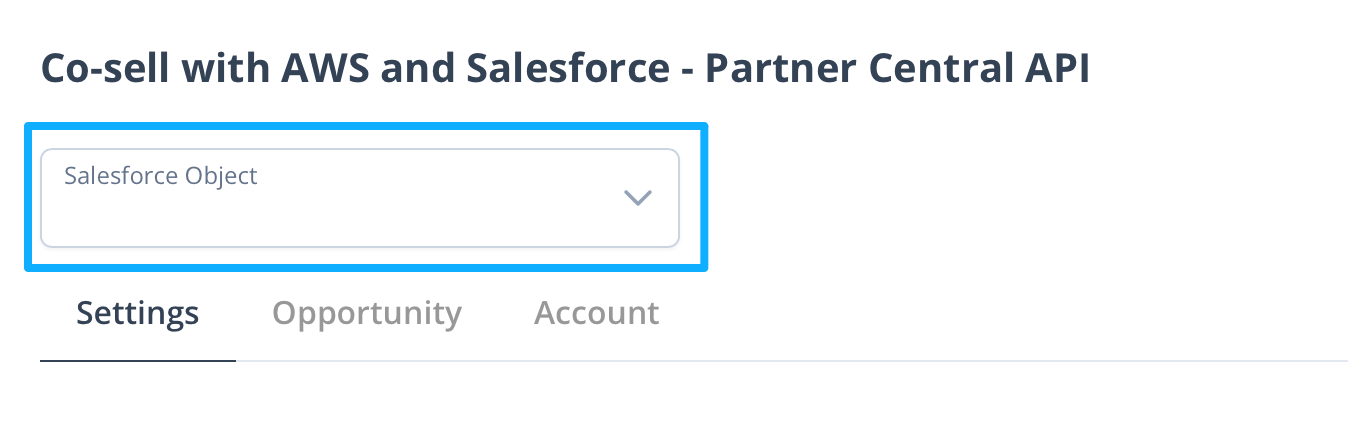
When syncing with Salesforce, you can use this field to search for and add more objects to sync, once the related field mappings have been completed. Mapping to custom Salesforce objects is supported, but typically requires a Solutions Engineering request to scope the trigger logic and data flow correctly. This isn’t available for HubSpot.
Setting
Auto-Accept Referrals
Automatically accept inbound referrals received from Cloud Partners.
When this option is enabled, Suger automatically changes the referral status to Accepted once it is received,
Auto-Delete Referrals
Enable Auto-Delete to automatically remove referrals that are rejected by YOU (the ISV).
When this option is turned on, once a referral is rejected, Suger will delete the corresponding opportunity/deal in your CRM and soft-delete the referral in the Suger Console.
By default, soft-deleted referrals are hidden from view and cannot be reused or referenced.
Auto-Sync Contacts
Automatically synchronize contact information received from Cloud Partners to your CRM system.
When enabled, contact details from inbound referrals (such as name, title, email, or phone number) are added or updated in your CRM’s contact records. Set SyncMode to “None” if you prefer to manage contacts manually.
CRM-Specific Setup
The mapping methods and automations above apply to both CRMs. A few setup steps are specific to each CRM.
Salesforce
Before configuring, confirm the Suger Salesforce package is installed and the Integration User is connected in your Suger Console:
- Integration User access: Salesforce must be connected to Suger with the Suger Integrator permission set, and that user needs Read and Edit access to any Salesforce fields you intend to map.
- Widget installation: The Suger Quick Panel must be added to your Opportunity page layout.
When defining outbound field mappings, pay special attention to these Salesforce fields:
- Owner attribution: Map
Owner.Emailso the correct sales rep is credited in the AWS/Azure/GCP portal. - Customer website:
Account.Websiteis used as the primary key for account matching and Auto-Enrichment. - Customer location: AWS and Azure require valid country codes. Make sure
Billing.Countryis mapped correctly. - Close date:
CloseDate— partners reject dates in the past or more than two years in the future. - ACE IDs: The
Partner CRM Unique ID(Opportunity ID) is usually mapped by default and doesn’t require manual configuration. - Project details:
Descriptionmaps to “Customer Problem” — the primary field partner managers read.
HubSpot
Before configuring, confirm HubSpot is connected and verified under Settings > Integrations, and that the Suger App is added to your HubSpot Deal “Default View” (see Set up the Suger App in HubSpot).
To let Suger write the partner’s status (e.g., “Active”, “Declined”) back to HubSpot, set up a Referral State property.
In HubSpot — create a property group (if needed):
- Go to Settings, then Properties under Data Management.
- Select Deal properties from the object dropdown, then open the Groups tab.
- Reuse an existing group, or click New Group and create one.
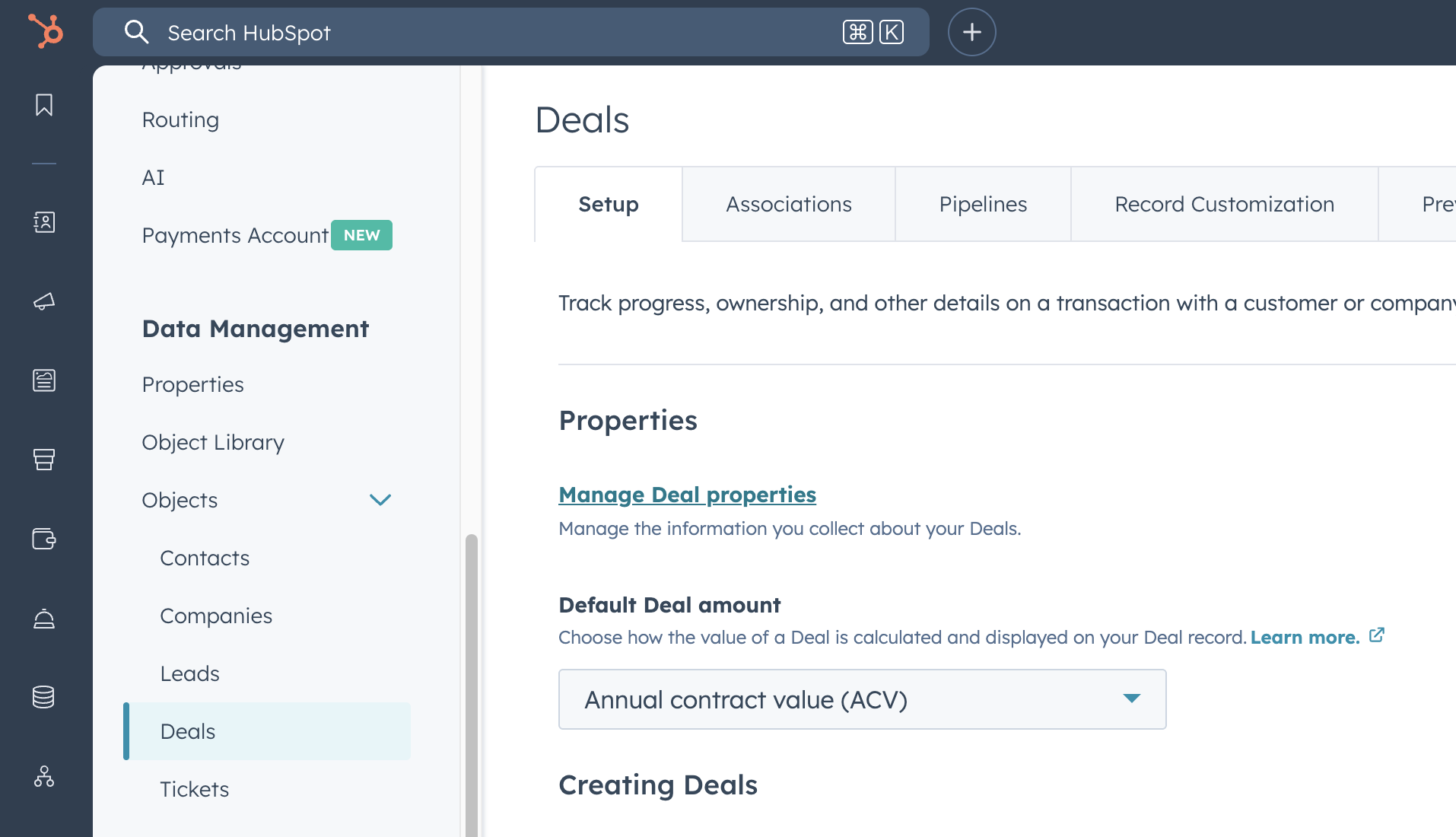
In HubSpot — create the property:
- On the Properties tab, click New Property.
- Confirm the object type is Deal, and choose your group.
- Label the property “Referral State” (or any name you prefer).
- Set the field type to Multiple Checkboxes.
- Add at least three options: AWS, Azure, and GCP. The option values must be consistent in case — they don’t need to be any particular case, just character-for-character consistent.
- Click Create.
In the Suger Console — register the property:
- Go to Settings > Integrations > HubSpot card, and click Edit.
- In the Advanced section, find Deal Referral State Property.
- Enter the property’s Label (not its Internal Name). If it isn’t listed, click the refresh icon to reload it.
- Click Verify, then Save.
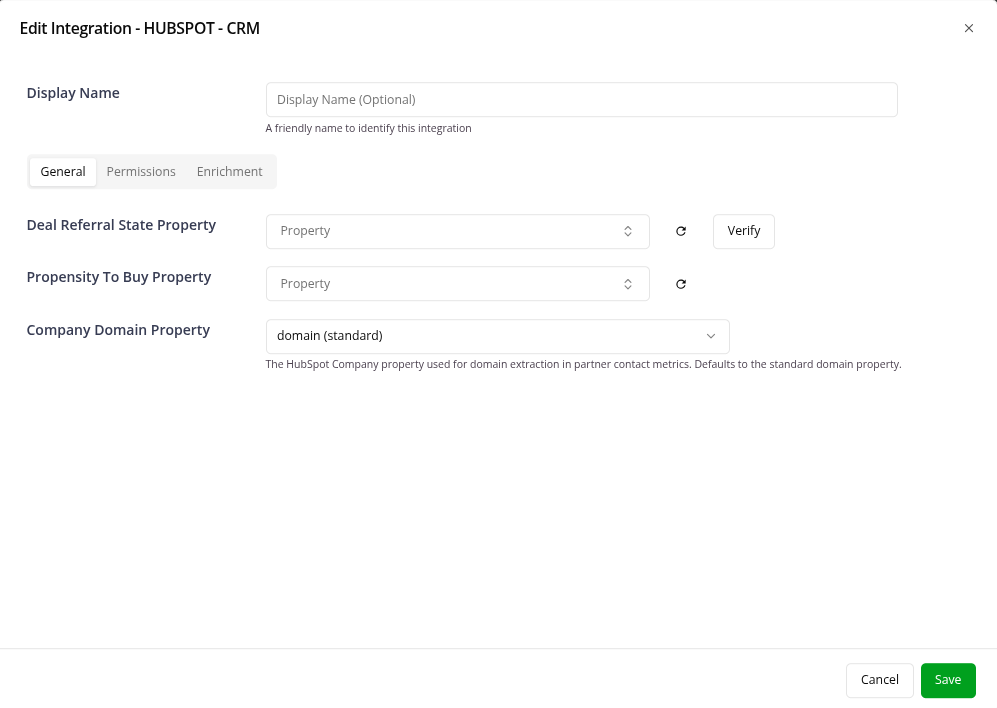
- Back on the HubSpot integration, click Sync to populate the referral state on existing deals. This can take several minutes.
Test Field Mapping
Use the  button to verify whether your field mapping configuration works as expected.
Test Mapping is available on the Outbound field-mapping step only. There is no equivalent test on the Inbound tabs — to check inbound behaviour, watch what an actual inbound referral writes into your CRM.
The test lists referrals created in your CRM, ready to be converted for the cloud partner. Click any row to inspect its source data and the converted data mapped to the target schema. Review each key–value pair to ensure the mapping behaves as expected based on your configuration.
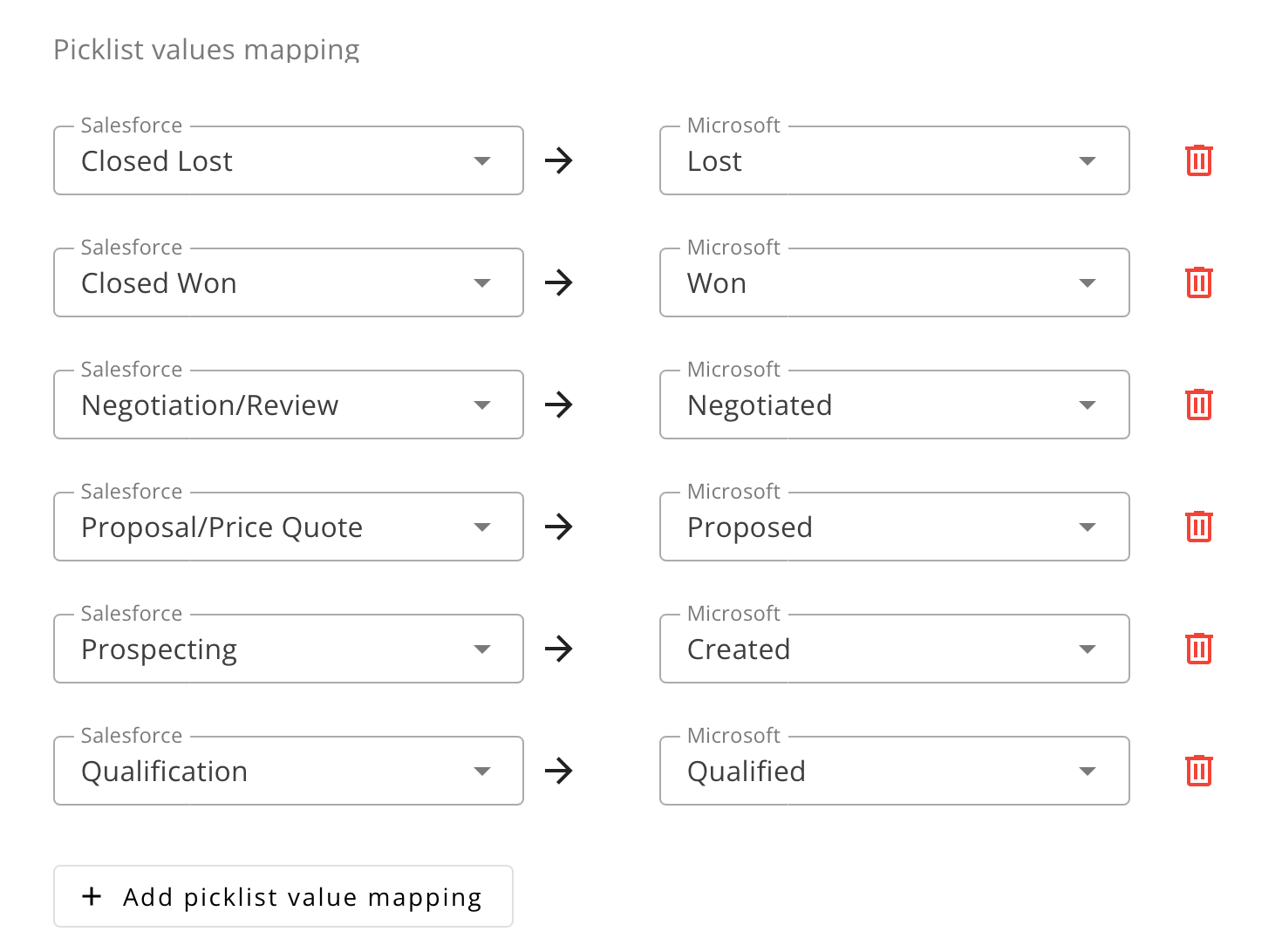
Picklist Value Mapping
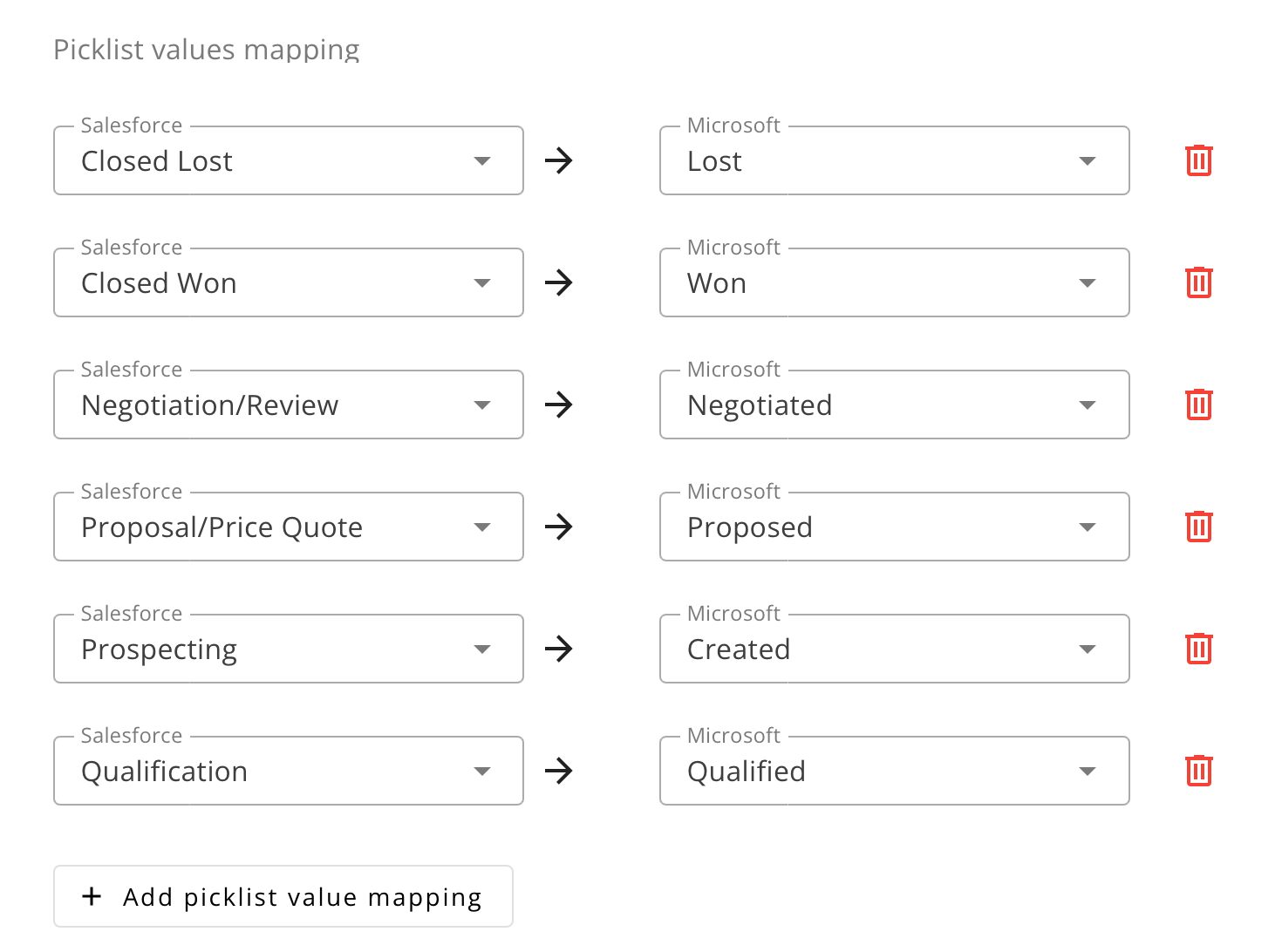
Some fields support Picklist Value Mapping, which allows you to define value correspondences between your CRM and Cloud Partner Platform.
This feature is used to create simple one-to-one mappings between different picklist values.
For example, the image above shows a Stage Name mapping where Salesforce stages are mapped to their corresponding Microsoft stages.
In other fields, you may need to enter values manually instead of selecting them from dropdown lists.
Users can add or remove mapping rows as needed to customize how each value aligns between the CRM and Cloud Partner.
Expression Mode
Expression Mode lets you build advanced field-mapping logic—such as conditional rules, value transforms, fallbacks, and simple calculations—when syncing data between your CRM and Cloud Partner.
How to enable
Click the {} button to the right of a field’s dropdown to switch that field to Expression Mode.
What you can do
- Conditional mapping (if/else)
- Default/fallback values for empty fields
- String/number transforms and simple calculations
- Cross-field lookups (read one field to populate another)
Example — set a default country when empty
The snippet below writes the company country if present; otherwise it uses USA.
{{- if .companies.country -}}
  {{ .companies.country }}
{{- else -}}
  USA
{{- end -}}
Syntax
Expression Mode uses Go Templates (text/template).
Reference: https://pkg.go.dev/text/template
Validation & troubleshooting
- Invalid template syntax will cause the sync to fail for that field.
- Use the
Testfunction to verify output before saving. - Ensure referenced paths (e.g., .companies.country) exist in your inbound/outbound payload.
Sync Timing & History
Once a referral is shared or accepted, Suger keeps it in sync across your CRM, Suger, and the cloud partner for the life of the deal.
- Outbound syncs (CRM → partner) run roughly every 6 hours.
- Inbound syncs (partner → CRM) run roughly every 3 hours, with new inbound referrals usually detected within minutes.
- You can trigger either sync manually at any time — actions taken directly in the Suger widget (such as sharing a new referral) run immediately rather than waiting on the schedule.
Referrals in an inactive state (Draft, Rejected, Expired, or Closed) are not re-synced. If the same field is updated in both your CRM and the partner portal between sync cycles, the most recent change wins — turn off a field’s Sync Fields toggle if it shouldn’t sync at all.
Click the History button on the Co-sell page for a timestamped log of configuration changes, including who changed the mapping logic and when. You can also review sync runs under Metrics > Logs, filtering Workflow Type to Sync.
Troubleshooting Common Issues
| Issue | Cause | Resolution |
|---|---|---|
| Engagement Scores missing in CRM | Co-sell Intelligence has not been enabled for your org, or your org exceeded its retrieval quota | Contact support@suger.io to have the signals enabled, then check usage in the Quotas tab |
| Can’t create a second config for the same partner | Only one active configuration is allowed per hyperscaler | Edit the existing config instead of creating a new one, or deactivate it first |
| ”This configuration was modified by another user…” when saving | Two people had the same configuration open and the other person saved first | Reload the configuration to pick up their change, reapply your edit, and save again. Agree who owns a configuration before a joint editing session |
| ”This field is already synced by another filler” | Two field fillers both claim sync on the same partner field — a field can be claimed by only one | Remove the duplicate claim: decide which filler should own the field and turn sync off on the other |
| Field empty on the share page | The mapping points to a CRM field that’s blank on that record | Populate the missing data in your CRM and reload the share page, or add a Default Value in the configuration |
| Field highlighted in red on the share page | Data validation failure (e.g., text in a date field, invalid country code) | Use Expression Mode to reformat the data, or switch to a source field matching the partner’s required data type |
| ”unsupported partner: X” | Incorrect capitalization in Expression Mode or Apex actions | Use ALL CAPS for partner references: AWS, AZURE, GCP. In HubSpot, the checkbox option values must also match character-for-character |
| Referral status not updating in HubSpot | The Referral State property Label in Suger doesn’t match the property in HubSpot | Re-enter the property’s Label (not Internal Name) under Integrations > HubSpot > Advanced > Deal Referral State Property |
| Auto-Share failed to trigger | Invalid SOQL predicate (Salesforce) or incorrect ILS Segment ID (HubSpot) | Salesforce: click Preview matches to test the criteria, use single quotes for strings. HubSpot: verify the ID matches the ILS Segment ID in Segment details |
| Sync failed after a stage change | A CRM stage was moved to a value not defined in Picklist Mapping | Locate the Stage field in the configuration and map every active CRM picklist value |
| Enrichment didn’t fill fields | Missing a valid company website or domain on the CRM record | Populate the Website field on the Account/Company record — Suger uses it as the enrichment primary key |
| A change hasn’t appeared yet | Waiting on the scheduled sync | Outbound runs roughly every 6 hours, inbound roughly every 3 hours. Trigger a manual sync if you need it sooner |
| Referral shows “Create Failed” / “Update Failed” | Sync error | Hover over the status in the referral list, or open the referral’s detail page, for the specific partner error message |
Frequently Asked Questions
Q: Why isn’t the Engagement Score showing in my CRM? Either Co-sell Intelligence has not been enabled for your organization, or your organization has exceeded its retrieval quota. Co-sell Intelligence signals are enabled by Suger, not by your team — contact support@suger.io to have them switched on, and check your usage in the Quotas tab.
Q: How do I turn Co-sell Intelligence signals on or off myself? You can’t — the enable toggles are managed by Suger and are not exposed in your Settings > Co-sell page. Contact support@suger.io with which cloud partners you want covered.
Q: What happens if I delete a Co-sell configuration? Deletion is immediate and permanent. All associated mapping logic and access tokens are removed, with no way to recover it.
Q: How do I handle fields with different names in different CRMs? Co-Sell configuration is unique per hyperscaler. You define the logic once for AWS pointing to Salesforce fields, and once for AWS pointing to HubSpot fields — full flexibility per CRM.
Q: Does Suger support currency conversion in Expression Mode? Yes. Since some partners (like AWS) require revenue in specific currencies, you can write an expression that multiplies your CRM amount field by a conversion rate before it’s sent to the partner.
Q: What happens if I move a deal to a CRM stage I haven’t mapped? The sync will fail for that update. Every active stage in your CRM should be mapped to a partner-approved value in Picklist Mapping.
Q: Can I map data from custom objects instead of standard Opportunity/Deal objects? Mapping to custom Salesforce objects is supported, but typically requires a Solutions Engineering request to scope the trigger logic and data flow. This isn’t available for HubSpot.
Q: Will Auto-Enrich overwrite data my sales reps have already entered? No. Enrichment only populates fields that are currently empty. If a field already has data, Suger treats your CRM as the source of truth and skips it.
Q: Can I automate deal sharing for only a subset of my team? Yes. Use Auto-Share criteria — the Builder or Advanced (SOQL) for Salesforce, Segments for HubSpot — to limit automation to specific owners, regions, or product lines. Use Preview matches (Salesforce) to verify which records currently match before enabling it.
Q: Why does a referral status show as “Expired”? A referral enters Expired when it isn’t approved or rejected within the partner’s time limit. This applies to AWS and Azure; GCP has no documented Expired state.
Q: Where can I see why a referral failed to sync? Hover over a Create Failed or Update Failed status in the referral list, or open the referral’s detail page, for the specific error message from the cloud partner.
Q: Do Suger roles (Admin, Editor, Viewer) inherit from Salesforce or HubSpot? No. Suger roles are console-specific and don’t inherit from CRM profiles or roles. Manage Suger permissions under Settings > Users & Roles.
Spotted something wrong or out of date on this page? Tell us and we'll correct it.